My candle burns at both ends
It will not last the night;
But ah, my foes, and oh, my friends -
It gives a lovely light.
Edna St. Vincent Millay
Book Review Tuberous Begonias an essential guide by Jack Larter

My buddy (and award winning begonia grower) Paul Carlisle sent me this book and it was a real eye opener for me.
I wrote in a previous post about tuberous begonias being the ideal pot plant that “A little fussing will give you a lot of rewards. A lot of fussing will get you a prize winner”. Well, this is that book about the lot of fussing getting a prize winner. Mr. Larter is a prize wining begonia grower in the competitive arena of the British Flower Show. I don’t know if we have anything quite as extreme as the lofty rarefied air of the British Flower Show in this country.
I know realize that I am only half a begonia grower. I know how to produce seed and tubers, I know how to breed true lines that give a high percentage of good double flowers on sturdy plants. But how to take those subsequent tubers and get the most flower performance from them has been outside my ken.
Although this book does cover all aspects of growing tuberous begonias and would therefore be a benefit to beginners, it’s main purpose is how to plan for, grow and ultimately show tuberous begonias in a flower show. The author specializes in showing cut blooms, just flowers without plant. See below a photo from the book of this kind of show.
 |
| Begonia "Cut Flower" show |
The author describes how he grows these huge blooms he also discusses growing pots and hanging baskets for show, as well as garden planting. Below are the table of contents and a sample page.
 |
| Table of contents |
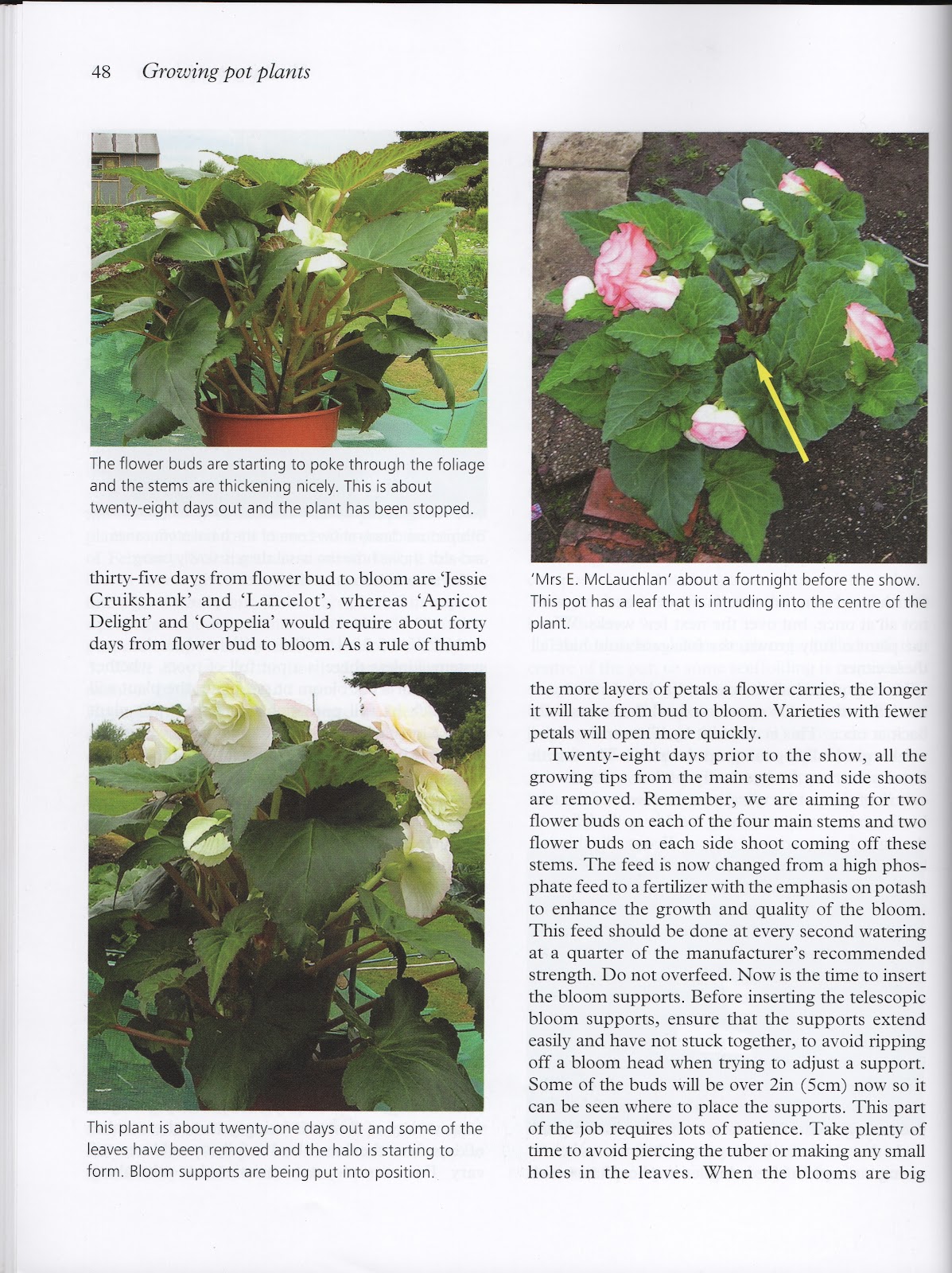 |
| Page 48, Tuberous Begonias by Jack Larter |
I have had occasion to show our begonias. Golden State Bulb Growers participates in the “California Pack Trials” every year. This is an event where horticulture companies up and down California show their products to potential customers. By co-operating on the timing of this event, visitors from all over the world can come and see the hort products of the Golden State at one time. Anyway, we always show begonias although frankly it’s more about callas. Callas suit the professional grower model better than begonias, I wrote about that in the previous post about container plants. We always show begonias from seed at about 17 weeks. For tubers, we just plant them 10 or 12 weeks before the show, hanging basket pots, a bit earlier. I am definitely going to try some of Mr. Larter’s techniques to improve our show.
For show pots Mr. Larter shows his pots, at 5 or 6 months after planting, all blooms that develop before the show blooms are removed, all blooms that are too late for the show are removed, after the buds are selected the plant is “stopped” by pinching the growing points.. Counting the days back from the show date and measuring the buds allows him to chose which blooms are likely to be ready on time. He hedges his bet by having several plants of the same type on slightly different schedules. All effort is to produce a glorious plant for one particular date. For his specialty, the cut flower competition, Mr. Larter grows only one flower per plant!
 |
| OMG tuberous begonia from Mr. Larter's book. Plant grown by Denis Hague |
 |
| OMG #2 Tuberous begonia from Larter's book. Plant grown by Denis Hague |
After the plant has produced it’s glory on the date, the plant is done (hence my quote at the top of this article about the candle burning at both ends) This is not, of course, what I believe the 98% of begonia growers do, we want the bloom all through the summer ‘till fall.
I now understand why Blackmore and Langdon begonias are so prized by the elite begonia grower. The reason is that they have a history of winning prizes at this level. Frankly, I have always been jealous of B & L’s reputation. I know that I can walk though our fields and find lots of begonias that, I think, look as good. However, seeing a horse that looks as good as a race winner is different from being a race winner, isn’t it?
I also wonder how difficult it would be to get a new, never seen before begonia to be accepted by judges that are used to seeing certain begonias over and over from competitor to competitor. I am thinking about the exalted British Flower show now, I am sure you can win at the local county or state fair with our begonias. Please try, and send me a photo.
Competition is a funny thing, especially judged competition. Judges are drawn from the ranks of former competitors, they know all the players. It must be hard for them to separate the competitor from the display. I have had some experiences with competition, (though not in flower shows). Competition can bring out your best on the day, but it’s real value is the day to day preparation for competition. I think the author of this book enjoys the day to day effort engendered by the shows very much. I judge this because he has named the two greenhouses, where all this fussing occurs as “Heaven” and “Paradise”!
Mr. Larter’s source list is hopelessly out of date despite the copyright date of 2011. He still lists the Carmel Valley Begonia Gardens as a source and that business hasn’t been in existence for at least 10 years, maybe more like 15. Antonelli begonias, also listed as a source for begonias in the U.S and by 2011 it was owned by Golden State Bulb Growers. We, on the other hand, don’t get a mention, despite the fact that we have been growing begonias for four generations and were, at one time, the largest grower of tuberous begonias in the world . We have also have an active and successful breeding program that has produced unique products. Do I sound disappointed? I guess this is the fate of a company that has been devoted to wholesale and not retail. To be honest, this is one of the reasons I started this blog, I want to stop laboring in obscurity.
Another thing that bothered me about the book in a minor way, is the use of brand names for his fertilizer recommendations, such as “use Chempak No 2 at half the recommended strength” I would have preferred “use 25:15:15 at 150ppm N”. or whatever, I guess that’s what I’m used to. But it’s a small point the strength of the book is the scheduling and the ability of the author to make the reader feel that they too could grow these award winning plants.
All in all an informative book.
-Andy Snow
