Showing posts with label Tubers. Show all posts

Saturday, January 19, 2013

Degrees of Good

Or: Up from industry.. to what?

“The best is the enemy of the good.” Voltaire

What Voltaire meant by this famous quote is that we often sacrifice what’s right, fine and, good to try for something that’s maybe just a little better. 

I know several people that are excellent in their chosen field.  Excellent martial artist, excellent musician.  The thing is, their lives are all screwed up.  Because life is about balance, not extremes. Excellent is extreme.

I am a believer in moderation in all things. Of course you have to include moderation in that equation too.  I mean come on, don’t take your moderation to an extreme. Get excited about something.  Play music ‘till late at night once in a while. Prune your front hedge to look like circus animals and dinosaurs. Or whatever.

What does this have to do with begonias?  Why does it always have to be about begonias?

I’ll tell you.

Judith Taylor in her article, The Begonia in California wrote “The Brown Bulb Ranch grew tuberous begonias on an industrial scale in Capitola for many years. The firm saw the possibilities in the mass market and grew millions of plants each year”

I don’t know about you, but it kind of makes me feel like we’re Folgers coffee or Budweiser Beer. 

 We’re better than that, maybe not excellent, but good, we were back then and we are more so now.

It is a fact that we have based our business, whether begonia or calla, on seed.  Our company was very involved in developing true seed strains of tuberous begonias (our company history says we ARE the developers of lines that are true for color)  Previous to true lines, all tuberous begonia hybrids were vegetatively propagated and very expensive.  Seed lines enabled us to bring the price of tuberous begonias down and produce millions for the market place.  That’s good, maybe it’s not excellent, but is it industrial?

 My job is to breed seed lines that are as good as I can make them.  But the fact is that all seed lines are kind of a crap shoot (except true F1s).  The genes recombine and the dice roll.  I have some lines in which every male bloom is a solid multi-petaled double.  Others, well, not so much.  I look at all our 54 varieties and decide which are the weakest. Then for a few years, we work on those and improve them.

The only other successful seed grown begonia is the Non-Stop.  A popular begonia with smaller flowers suited to garden beds and, so I am told, very popular as cemetery plantings in Europe.  In parts of Canada, Non-Stop is synonymous with tuberous begonia; like Kleenex is synonymous with face tissue, (again something I’ve been told).

Our equivalent to the Non-Stop is the On-Top. Get it? Non-Stop, On-Top.  The difference is ours are all bi-color or picotee because, at the time, we didn’t want to go head-to-head with Non Stops in the market place (they were too cheap).  Now they have picotees too, so it goes.

But our “standard” begonia is the large flowering “exhibition” type begonias (and hanging baskets).  You know, the spectacular ones.

Among the large flowered begonias there are degrees of good.  (And that’s only if we all agree on what’s desired in the realm of floral beauty, other opinions are welcome.)

Our seed lines knocked the socks off of Antonelli's seed lines.  I know, I grew Antonelli's begonias.  They brought me their seed and I returned to them tubers.  They had their own mother stock and genetics.  From their mother stock they took cuttings.   They called them Antonelli’s Champions.  They were all identical.  The best they had (we have those plants now).

Antonelli's Champions.  Notice my highlighter over the size. "1 inch (sometimes smaller)"! Holly smokes!


Blackmore and Langdon.  Great begonias. There's a mark for us to shoot at.  We could pick on them for this or that, I don’t like the fact that some have weak stems and don’t hold up the flowers very well.  But then again, the flowers are often huge.  Vegetatively propagated.  Expensive.

In some ways, cloning begonias is easier, you only have to find one good one.

The breeding may be easier but the production is harder and therefore, more expensive.

We vegetatively propagate only our Scented Begonias.

We used to have a program of named varieties that we (inside the company) called “Stake Stock” that were selected (staked) while the plants were in bloom and then hand dug before the Green Monster went through the field.  I’ve tried to reinstitute that program a couple time, with no success.  The sales department didn’t sell them, the warehouse crew threw them out and when  I sent a couple of the tubers to Paul Carlisle and I saw them in his greenhouse, I was not impressed with the results.  We will have to improve our performance if we want reinvigorate that program.  Next year, I will make the selections myself.

"Stake Stock" in our 1978 Catalog

Cover from the catalog above


But, let’s run the numbers.  Let’s say 5% are junk, 90% are good and 5% are excellent (or maybe it’s 10%-80%-10% or  20%-60%-20% whatever).  Do you want to pay me to find the 5% for you and charge you for that, or do you just want to buy a few tubers for the same price as the one I selected and take your chances?  You might get the junk, you’ll likely get the good and you might get the great.  The collection of begonias that you decide to keep will reflect your taste, not mine.

So, the question is, and why I started writing all this about three pages ago is this; I am wondering if we should start a vegetatively propagated begonia program for more than just Scented Begonias?  It’ll be two years before the first ones could come along.

Should we have three degrees of good;  the Clones, the Stake Stock and the Seed Lines?

Could we become less “Industrial” would we become “boutique”?  Or is that just one more way to lose money?

Other news and note in our tuberous begonia world.  Paul Carlisle and his lovely wife Laurel had a great article in the “Begonian”, which is the magazine of the American Begonia Society.  Great article, great photos and a wonderful cover shot by Gary Hunt.


For more of photos of Paul’s begonias by Gary Hunt clink here.

For an article I wrote about Paul click here.


-Andy

Monday, December 24, 2012

The Green Monster and a 5 foot Horizontal Blue Flame


Or Here We Go Again!

It’s tough this time of year. I never liked winter, that’s why I moved to California forty years ago, but there’s always winter, isn’t there? 

The days short, I go to work in the dark and return home in the dark, morning and evening chores are done in the dark.  Moods are dark, the weather dismal.

I was so happy last Friday when at 3:12 am we finally turned the corner and our half of the planet started to turn toward the sun instead of away from it.   Better days are ahead.

It is at this time of no-flowers-anywhere that we dig our begonia crop.  It’s the busy season, the soil and sky dark, wet, and heavy.  Dark, wet and busy, the joy of this season evades me. 

As I write this piece, two days before Christmas, the rain is bucketing down and has been for days. 

The begonias were happily going to sleep in their wet soil, maybe they would have died there, maybe they would have risen next summer and been a glory again, but they are saved from whatever their fate might have been now that they are meeting the Green Monster. When its time has come, The Green Monster is called out. The Green Monster stops only for dark- not rain, not mud. 


The Green Monster
The Green Monster, surrounded by his attendants, moves through the begonia fields


An old piece of agricultural equipment, the Green Monster is not used for any other purpose than to unearth begonia tubers.  The Green Monster is a modified potato digger; the blade passes under the tubers and they are lifted onto a broad chain that jumps a little on a small cam to shake some of the sand off. Then the lumps of soil are unceremoniously dumped into a bin, each with it’s tuber inside, and transported to Moss Landing, where most of the remaining soil is washed off and the begonias are dried, sorted and sold.

The washer dumps lots of recirculated water on the tubers, two settling ponds collect the Marina sand that gets hauled away in summer. And there’s the dryer.  Oh, the dryer.  The dryer is 3 standard shipping containers placed side by side and cut so that a hot wind driven down the center container is divided and driven back up the outer two.  The begonias, wet after being washed, are stacked on pallets and are subjected to this hot wind.

Many years ago the Brown Bulb Ranch dried apple pulp.  There were several companies around here that pressed apple cider and the pulp was recycled, after drying, to various uses.

One of the many burners that dried apple pulp now dries our begonias, supported by a big fan.  It’s magnificent in it is extravagant consumption of natural gas!  See below the video I took today of the begonia dryer.


This will be the thirtieth begonia crop that I have seen harvested, washed, dried, graded, counted, and shipped.

They hired me for just this work.  Thirty years ago I was big, young and strong (now I’m just big).  We used no equipment to unload the begonia boxes that arrived at the Brown Bulb Ranch from the fields; they arrived in wooden boxes on a flat bed truck. We unloaded them and dumped them, one by one, on the washer chain. Keeping track of the varieties by their numbers. We listened to football games on a little black radio that we kept dry.  It rained.

One more time, here we go again.  I wonder if I prayed to one of the ancient gods of agriculture, if they could lift the weight off me during this season and I too could rejoice in colored lights and wrapped packages. 


Turn towards the sun, little blue marble, the light is coming back, we are going to be born again, I am almost sure of it. 


Andy 

Wednesday, November 28, 2012

That’s not what I want to talk about.

Excuses, excuses, excuses

Well so much for my goal of getting out a couple blogs each month. 

I guess everyone has excuses, me too. 

We started calla harvest the middle of September and there are calla bulbs (or corms or tubers, whatever those confounded things are) everywhere. The warehouse is overflowing and they are stuffed into greenhouses and the old derelict mushroom plant down the road. 

But that’s not what I want to talk about.

I also went off in the middle of this busy time to study music with Fred Morrison for 4 days at Lake Tahoe. It was great fun and the weather and venue very pleasant.  The days challenging and the music after dinner delightful. The music just flows though Fred Morrison, like he’s some kind of conduit, and he gets such a kick out of it that he grins and laughs while he plays, like it tickles. This link shows Fred playing the Low D Whistle with his pipes on his lap.

Fred Morrison playing bellows blown Smallpipes

 But that’s not what I want to talk about.

We had a visit from Matthiuas Rohde of Rieger Begonias.  Rieger is in the business of producing begonias from cuttings.  They produce a begonia that is a cross between species of which one species is a tuberous begonia.  These crosses are also sometimes called hiemalis begonias.  But in our industry, Rieger’s begonias are so ubiquitous that their family name has come to mean a whole class of begonias. Mr. Rohde is the head of the family business now and a direct descendent of great grandpa Rieger.  Grandpa Rieger had only daughters and so none of the progeny carry his name.  Pity, I could have had my picture taken with a Mr. Rieger standing in our begonia fields.

We have a deal with Riegers where they will try and propagate our Scented Begonias from cuttings.   Since cutting begonias is their business (Riegers do not come true from seed), it stands a chance of being a way to get our Scented begonias to market.

But that’s not what I want to talk about.

I also had the wind taken out of my sails the other day. 

See, I was checking the links on this blog, the ones you see on the right, just to make sure they were all good.  ABS; check. Capitola Begonia Festival.  Check.  University of Minnesota:  Check. Our web site “Your Source for AmeriHybrid® Begonias”…our begonias…I got the message you see below.


What! No begonias?


I wrote, in a earlier blog, about our company culture being basically anti-retail but we aren’t even selling our own begonias! 

I, of course, went to talk to the sales guys and they gave me lots of disclaimers, reasons and qualifiers but said basically “we can’t have begonias on our web site or someone might buy them.”   I let that sink in a minute.

I went to our new CEO (me, rather disgruntled) CEO says he’s totally behind getting the begonias back to profitability through increasing sales.  Good for him.   He says there’s a new web site in the works. Good for him.  Going to be called CAbegonias.com.  “Good for you” says I, “when will it be up?” “End of January” says he.  Sooner, we all hope.

There’s some sort of ego thing going on here I know there is.  And I know, it’s my problem.  For 29 years I have bred tuberous begonias and I want to see them out in the public.  I like it when people are complimentary about the plants.  I even get some weird kind of second hand satisfaction when people grow our competitors tuberous begonias and like them.  And of course, now I’m blogging; another sign of an obviously out of control ego.

My wife says I need to detach.  I can, I suppose, continue to breed begonias for my own pleasure until our company declines to grow them any more.  Why would we stop growing them?  Well, because we don’t sell them!

Note:  Our begonias are available. Do a search for AmeriHybrid Begonias.  There are some nice web sites out there with our material that you can actually purchase.  I have updated the sidebar with some suppliers.

But that’s not what I want to talk about.  Not at all.

Tuesday, September 18, 2012

What's in a Name


Wholesale vs Retail

Among the many varied tasks I was assigned during my first year working for the Brown Bulb Ranch was covering our logo on shipping boxes.  All our boxes had, reasonably enough, our logo.   We had spray paint that was exactly the color of new cardboard and I would turn our logo boxes into generic boxes. 

This puzzled me at the time.  Wouldn’t we want the recipient of the boxes to know where the begonias came from?   I was informed that, no we did not. 

You see, our customer was a wholesale buyer who sold to the person to whom we were shipping, and our customer (the wholesaler) did not want the recipient to know where the begonias came from.  In that way the wholesaler (our customer) insured that his customer (the recipient) would have to come back to him if he wanted more of those wonderful begonias, he wouldn’t know where else to go.

These days what is called “Branding” is a big deal.  It’s such a big deal that people will pay more for a particular Brand even if there is no inherent value other than the name. T-shirts, shoes, whatever. A maker of tablet computers, for example, is able to demand four times what other tablets sell for because of their brand name. 

But that was not the original purpose of a Brand. Branding is supposed to be an assurance of quality, a “Name”, a reputation you could count on.

Because we considered ourselves to be wholesale and not retail, we were happy to support whomever was selling our product by making them seem like the Big Deal, the Producer, the Great Garden Provider, the Brand Name.    White Flower Farm had our Lace begonias on the cover of their catalog one year (wish I could find it, it’s just here somewhere) where inside we were called “Our California Grower”.  Being anonymous was a customer service.

But, hey!  They sold our begonias; as did Jackson and Perkins, David’s and Royston, Burpie and dozens of others, both high-end, middle of the road and Michigan Bulb.   We were stealth samurai begonia growers.  Egoless and free of the hordes of tourist that were clogging up the greenhouses of Vetterle and Antonelli with their picnics, weddings, and endless photographs.


Vetterle and Reinelt's "Cathedral of Begonias" Photographer Unknown


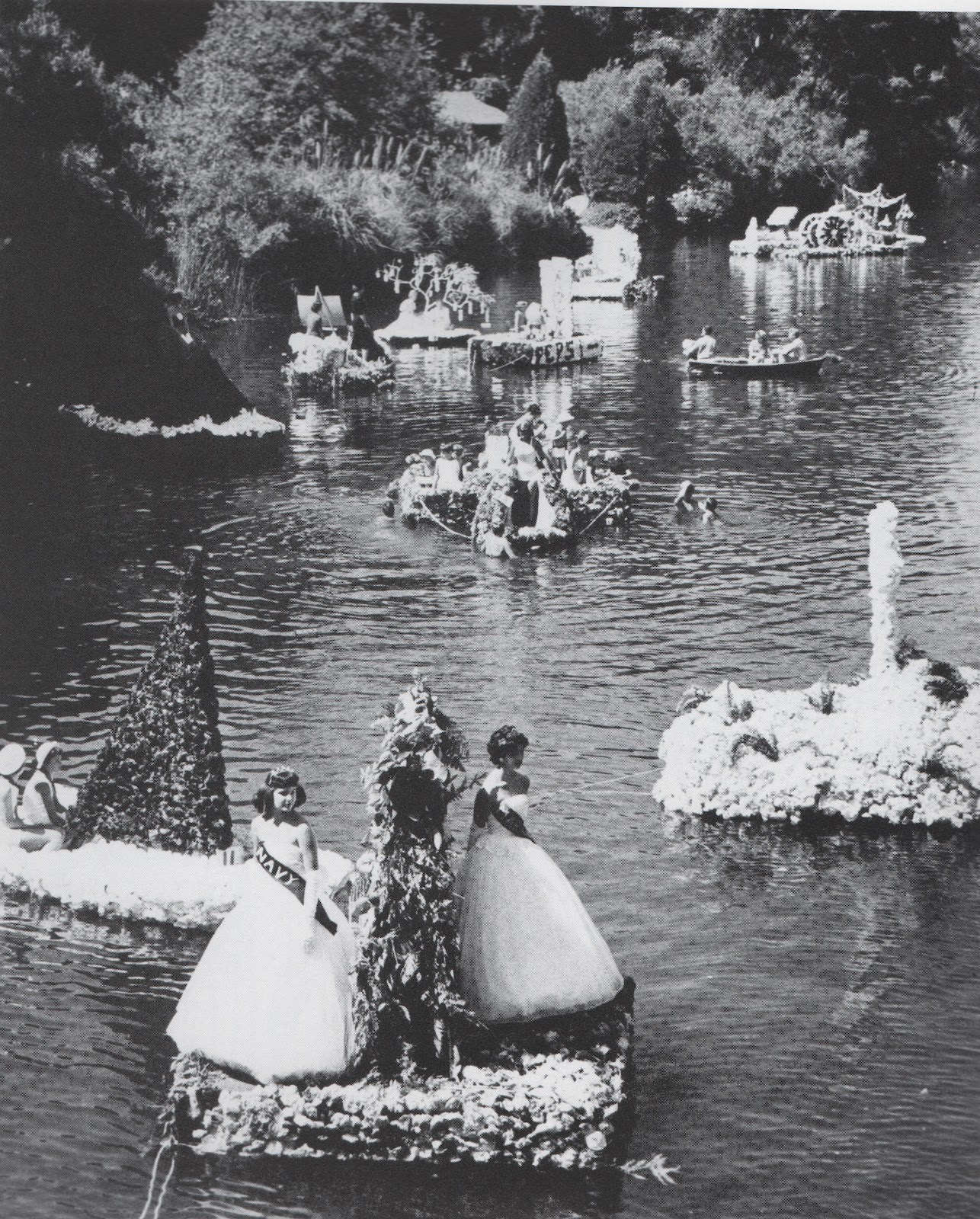
I used to live in Capitola, on the Old Ranch, and I would walk down to the Begonia Festival every September wearing my Brown Bulb Ranch hat.  Nobody knew who we were.  All the floats in the Nautical Parade are covered with begonias that we provided and nobody knew (these days the organizers are much better at giving us credit than they did then). 

If I mentioned to someone that I grew begonias for a living they would remark “You must work for Antonelli’s” 

“No, I work for Brown’s.”

 Blank look.  Followed by “Who?”


Capitola Begonia Festival 1959. 


Capitola begonia festival Floats2012 Photographer unknown
Capitola Begonia festival float 2012 Photographer unknown

Garden catalogs have pretty much gone away.  We are still a wholesale provider but most of our product goes to the professional grower, not the home gardener.  The professional grower is serviced by a “plant broker”.   The broker is now our customer.  Begonias don’t work very well for industrialized greenhouse operations.  Callas do. Where does that leave our begonia business? 

Needing to modernize you say?

Well, we are trying.  A few years ago we registered a brand name; The Amerihybrid® Begonia (ask for it by name! Accept no subsitute! Tell ‘em Andy sent you!)

Now, you have to admit that our begonia strategy was not without merit.  Of the four families that grew begonias around Capitola, we are the only ones still in business and still growing begonias (even if it is only 30% of what we grew in our heyday.)

Modernize.  These days that means the internet, right. 

There are things you can buy and things you can’t.  Reputation is not something you can buy.  Names however, you sometimes can.  

Antonelli Brothers produced about 3 acres of begonias, I know, I grew them.  We had about 30 acres.  Antonelli Brothers’ annual begonia sales revenue in the year before they closed was about the same as ours for the same year.  I don’t know about you, but that says something to me about the margins inherent in retail versus wholesale.  

Antonelli’s was a three generation family business.  When they were in Capitolia, the tour busses pulled up to their place during the bloom season. A visit to the beach at Capitolia-by-the-Sea was not complete without a visit to the famous Antonelli Begonia Gardens.  They were a Name.


Antonelli's 2009 Catalog.  The last one.


Golden State Bulb Growers now owns all of Antonelli’s begonia mother stock, we own what seed they had on hand when they decided to throw in the towel and some seed we have collected since.  We are, for all intents and purposes, Antonelli Begonias for the 21st century. 

Maybe that should be our retail brand.  What do you old time (no insult intended) begonia growers think?  Does the name “Antonelli Begonias” still have any cachet?  And if so, should we exploit it?

Retail is supposed to be customer centric.  That’s why retail gets the big markup, to pay for sales and customer support staff.  Wholesale is production centric, we rely on wholesale buyers and brokers to be our sales team and our customer support, that’s why they get to clip the ticket.  Golden State Bulb Growers is a very experienced production grower.  Servicing retail customers is not something we have much experience with… yet.  There is a lot of inertia around here and it is going to take a while to change.  But change is in the air.

Geez this sales stuff baffles me.   I’m gonna go make a few female begonia flowers pregnant. 

-Andy


Antonelli Begonia Gardens in the 60s.  Photographer Unknown


Antonelli Begonia Gardens Capitola California.  Photographer Unknown


Sunday, September 9, 2012

Paul Carlisle


Meet Paul Carlisle.

If you like tuberous begonias you should see what this guy does with them.

Paul is a begonia grower extraordinaire.  He knows all his tubers and their history.  He has an incredible way with his plants.

I first met Paul at the American Begonia Society convention in San Francisco in 2010.  We had talked on the phone a couple of times before the event and he invited me up to speak to the convention.  I liked him right off and we have kept in touch ever since.

It was Paul who sent me the book I reviewed in a previous post.   Paul readily admits that he likes the BIG flowered begonias and he knows how to achieve these though his careful management of the plants.  For example; he always picks off the first couple of blooms to allow the plant to get larger before developing bloom, and there wasn’t a female flower to be seen on any of his upright pots.

This year he fed with a  low Nitrogen fertilizer as the flowers were developing and was happy with the results

We visited him a couple weeks ago when Paul invited my wife, my son and me down to have lunch with him and his wife, Laurel
Let’s let take a look at what we found:


                          Stepping off the back porch, this is what you find


Fiona, full sibling to Fairy light by THAT English begonia company (Blackmore and Langdon)


That's me on the left and Paul Carlisle on the right.

One of many benches in Paul's shade house

Lola among the begonias
 Falstaff by that English Begonia company again.

He came to visit me today and we went out to the begonia fields and I was able to repay him by shouting for lunch at Sea Harvest in Moss Landing

He and his lovely wife have been growing begonias since the late 70’s (so, let’s see, that means he has been growing begonia longer them me –gasp!)  He started showing at County Fairs.

We have such a different eye to begonias he and I.  Because he grows the winners, he can spot the potential prize winner looking across a field (he dug a few I hope do well for him). Because I grow my seed crosses looking for the highest percent of good doubles, I only see the losers. 

Paul’s a stand up guy with a good since of humor and a breezy nature, we need more like him.  He’s the ambassador of begonias.

For more of pictures of his begonias see the posting here (this is a blog I need to catch up on with incredible photos, and they beat me to the punch with their scoop on Paul and their great Paul Carlisle begonia pictures)


Thursday, August 23, 2012

Tuberous Begonias by Jack Larter, a book review


My candle burns at both ends
It will not last the night;
But ah, my foes, and oh, my friends -
It gives a lovely light.
Edna St. Vincent Millay

Book Review Tuberous Begonias an essential guide  by Jack Larter 


My buddy (and award winning begonia grower) Paul Carlisle sent me this book and it was a real eye opener for me.

I wrote in a previous post about tuberous begonias being the ideal pot plant that “A little fussing will give you a lot of rewards.  A lot of fussing will get you a prize winner”.  Well, this is that book about the lot of fussing getting a prize winner.  Mr. Larter is a prize wining begonia grower in the competitive arena of the British Flower Show.  I don’t know if we have anything quite as extreme as the lofty rarefied air of the British Flower Show in this country.  

I know realize that I am only half a begonia grower.  I know how to produce seed and tubers, I know how to breed true lines that give a high percentage of good double flowers on sturdy plants.  But how to take those subsequent tubers and get the most flower performance from them has been outside my ken.

Although this book does cover all aspects of growing tuberous begonias and would therefore be a benefit to beginners, it’s main purpose is how to plan for, grow and ultimately show tuberous begonias in a flower show.  The author specializes in showing cut blooms, just flowers without plant.  See below a photo from the book of this kind of show. 

Begonia "Cut Flower" show
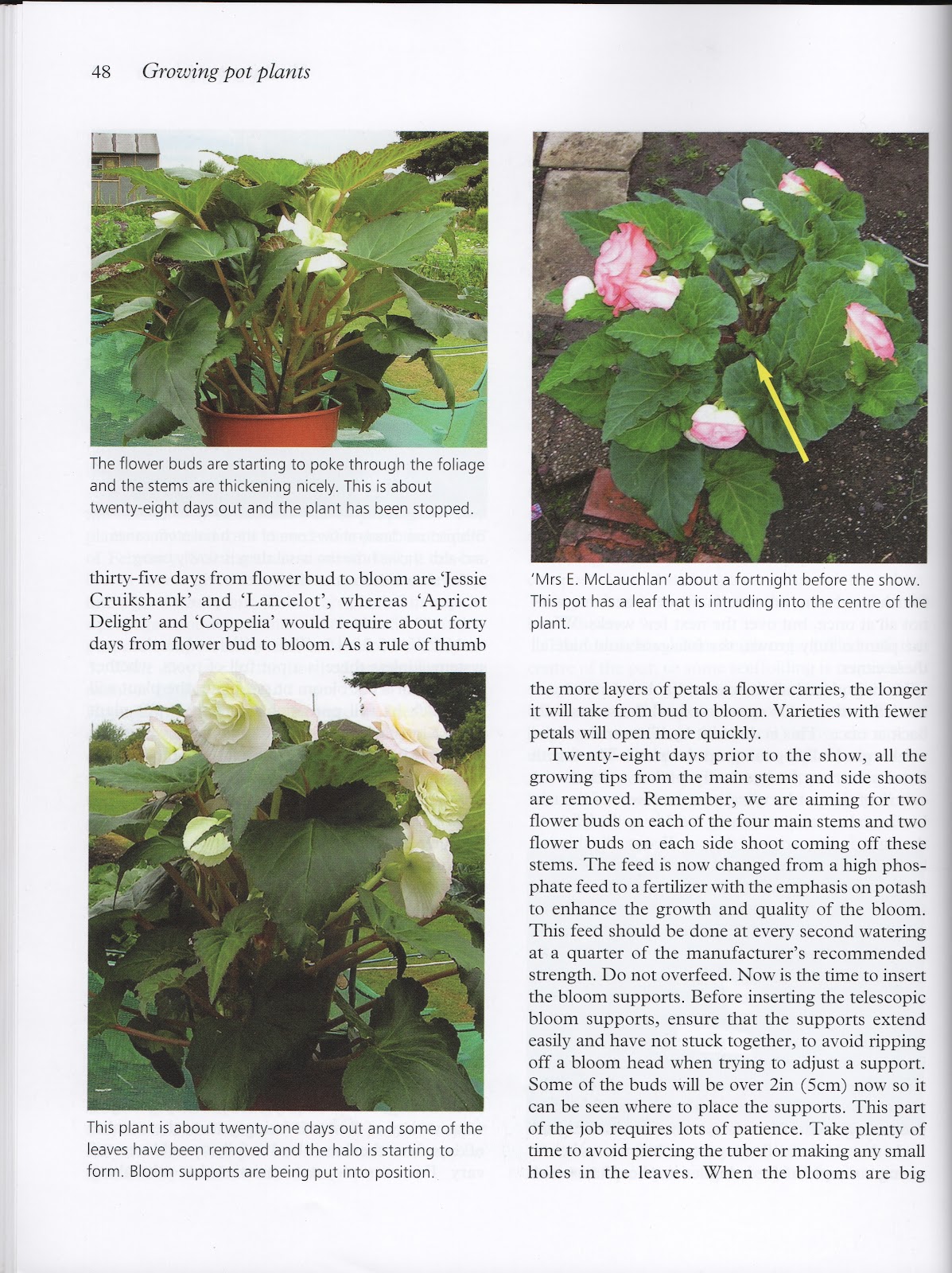
 The author describes how he grows these huge blooms he also discusses growing pots and hanging baskets for show, as well as garden planting.  Below are the table of contents and a sample page.


Table of contents


Page 48, Tuberous Begonias by Jack Larter

I have had occasion to show our begonias.  Golden State Bulb Growers participates in the “California Pack Trials” every year.  This is an event where horticulture companies up and down California show their products to potential customers.  By co-operating on the timing of this event, visitors from all over the world can come and see the hort products of the Golden State at one time.  Anyway, we always show begonias although frankly it’s more about callas. Callas suit the professional grower model better than begonias, I wrote about that in the previous post about container plants.  We always show begonias from seed at about 17 weeks.  For tubers, we just plant them 10 or 12 weeks before the show, hanging basket pots, a bit earlier.  I am definitely going to try some of Mr. Larter’s techniques to improve our show.

 For show pots Mr. Larter shows his pots, at 5 or 6 months after planting, all blooms that develop before the show blooms are removed, all blooms that are too late for the show are removed, after the buds are selected the plant is “stopped” by pinching the growing points..  Counting the days back from the show date and measuring the buds allows him to chose which blooms are likely to be ready on time.  He hedges his bet by having several plants of the same type on slightly different schedules.  All effort is to produce a glorious plant for one particular date.  For his specialty, the cut flower competition, Mr. Larter grows only one flower per plant!


OMG tuberous begonia from Mr. Larter's book. Plant grown by Denis Hague

OMG #2 Tuberous begonia from Larter's book. Plant grown by Denis Hague

After the plant has produced it’s glory on the date, the plant is done (hence my quote at the top of this article about the candle burning at both ends)  This is not, of course, what I believe the 98% of begonia growers do, we want the bloom all through the summer ‘till fall.

I now understand why Blackmore and Langdon begonias are so prized by the elite begonia grower.  The reason is that they have a history of winning prizes at this level.  Frankly, I have always been jealous of B & L’s reputation.  I know that I can walk though our fields and find lots of begonias that, I think, look as good.  However, seeing a horse that looks as good as a race winner is different from being a race winner, isn’t it? 

I also wonder how difficult it would be to get a new, never seen before begonia to be accepted by judges that are used to seeing certain begonias over and over from competitor to competitor.  I am thinking about the exalted British Flower show now, I am sure you can win at the local county or state fair with our begonias.  Please try, and send me a photo.

Competition is a funny thing, especially judged competition.  Judges are drawn from the ranks of former competitors, they know all the players.  It must be hard for them to separate the competitor from the display.  I have had some experiences with competition, (though not in flower shows).   Competition can bring out your best on the day, but it’s real value is the day to day preparation for competition.  I think the author of this book enjoys the day to day effort engendered by the shows very much.  I judge this because he has named the two greenhouses, where all this fussing occurs as “Heaven” and “Paradise”!


Mr. Larter’s source list is hopelessly out of date despite the copyright date of 2011.  He still lists the Carmel Valley Begonia Gardens as a source and that business hasn’t been in existence for at least 10 years, maybe more like 15.  Antonelli begonias, also listed as a source for begonias in the U.S and by 2011 it was owned by Golden State Bulb Growers.   We, on the other hand, don’t get a mention, despite the fact that we have been growing begonias for four generations and were, at one time, the largest grower of tuberous begonias in the world .  We have also have an active and successful breeding program that has produced unique products.  Do I sound disappointed?  I guess this is the fate of a company that has been devoted to wholesale and not retail.  To be honest, this is one of the reasons I started this blog, I want to stop laboring in obscurity.

Another thing that bothered me about the book in a minor way, is the use of brand names for his fertilizer recommendations, such as “use Chempak No 2 at half the recommended strength”  I would have preferred “use 25:15:15 at 150ppm N”. or whatever, I guess that’s what I’m used to.  But it’s a small point the strength of the book is the scheduling and the ability of the author to make the reader feel that they too could grow these award winning plants.

All in all an informative book.

-Andy Snow

Wednesday, August 15, 2012

Begonia Breeding at Golden State Bulb Growers

Warning, this post contains a lengthy description of our begonia breeding program, I am afraid it will be terribly boring for the general reader (and maybe everyone else too).

When I became the begonia breeder for Golden State Bulb Growers (at that time the Brown Bulb Ranch) the Begonia x Tuberhybrida was already a well established product with a world wide market.  Tuberous begonias were among the first begonia species to be hybridized. 

I am happy to give a history of tuberous begonia breeding, but I am sure that information is available elsewhere.

Although I have messed around with species begonias, my real work has always been within the established hybrids. 

Growing tuberous begonias from seed for tubers is our business, and it has an inherent problem that the vegetative producer does not face.  Our goal is perfectly formed, large male flower (It is the male flower that is so showy).  The ideal flower is, however, sterile.  So, we must keep some imperfect flowering plants around to provide pollen.  Pollen is our most precious commodity, not seed.  Give me good pollen, I will produce enough good seed.  Good pollen comes late, or some years, not at all.  A plant that will contribute it’s pollen but not its characteristic for imperfect flowers in rare.  The resulting crosses are therefore not entirely uniformly perfect.  I strive, as a breeder to keep the percentages of good double flowers high, in some types it approaches 100%, other types; not so much.

In a previous post, I showed an old photo of myself and Todd Brown grading crosses in Marina. 

We used these crosses to evaluate our mother stock.  We would take the pollen from one pollen plant (called a “sire”) and put it on a specific seed parent (called a “dam”) we would hang a little paper tag on the pod that received the pollen with both parent’s numbers.  In this way we could grade the mother stock by looking at the crosses.  We would, for example, look at a series of plantings where the only difference was the sire, same dam.  We could then deduce that any variation in the population was due to the sire.  Also, if all the crosses were bad, we could deduce that the sire was not so good.  Same was done where the sire was the same, different dams, same deductive procedure.  We graded for both flowers and plant form because we are always looking for crosses that present the bloom well. We also brought in unique individuals we found for future mother stock.   

In this way we rated our mother stock plants from A to C with plus and minus, making 10 grades.  We wrote out a score card for each plant that stayed with the tuber.  This score card would record how it performed in crosses, how reliable the pollen production is (if a sire) and other characteristics .  Every year we rewrote the score card adding that years information.  With over 6,000 mother stock writing the cards was a big job.  Every year we discarded the mother stock that got the worse grades and added pots from our previous years selections.

 Below you see a picture of me making crosses in the 80s, the score cards are clearly visible in the photo.  The thing around my neck is a metal holder that contains a rectangular piece of glass that has been painted black on the back side, this was used for collecting pollen that was applied to the female flower (begonias being monoecious) using a small brush.


We would arrange the mother stock pots on the bench by type, then by the grade of the individual.  For example, the first pot on the bench would be the highest graded sire, the next one the second graded sire etc. After the sires came the dams, highest rated first.  We would also cut our highest rated parents.  This arranging was done so that the pollinator would take all the available pollen from the highest rated sire and only after that was exhausted, go to the second highest rated.  Conversely, if only a small amount of pollen was available, it would go on the highest rated dam.  All female flowers had to be pollinated or picked so that no dud pods would be processed.  When we pollinate a flower, we nick a petal with our fingernails to show the work is done and not waste additional pollen on that flower again.

After a few years, it became obvious that a better solution was to find the one best cross, whatever the parents, and make that cross over and over again until a better one could be found.  This was achieved by actively cutting the best parents until we had enough pollen and seed parents to supply all the seed we needed.  Recently, we have been able to do this with tissue culture. This is easier said than done, some individual begonias just do not take well from cuttings, unless you take a bit of tuber with the cutting, I don’t know why.  The same ones that don’t cut well, don’t tissue culture well. (If anyone reading this has a good cutting protocol, can you please share it in the comments.)

The only danger in this improvement in our seed production, is that it is tempting to discard mother stock plants that are not, anymore, being used for production.  There is an economic incentive to keep the mother stock as lean as possible.  We therefore risk losing genetic diversity.  We keep old seed and seed from past crosses as well as a good selection of non-productive plants for this reason.

Plant breeders sometimes use inbreeding as a technique and Worth Brown mentions using this tool with begonias, in his book “Tuberous Begonias” published in 1948.  We also use inbreeding to get new types and make improvements in existing types.  Begonias do not take well to being inbred and the breeder soon loses germination and vigor.  However, it is much easier to get that one characteristic your looking for. You can inbreed either by putting the plants pollen on it’s own female flowers called a “self” on the another individual with the exact same parents called a “sib” (short for sibling). 

In order to pull this program off, you have to have two lines going with the characteristic you want.  The two lines are not related.  When both lines come true, no mater how weak they seem, you can re-combine the two lines and get back the hybrid vigor that you lost during inbreeding.  Sometime times further work is needed past the F1 stage to make a fully marketable plant.

Using this technique, we were able to develop the On Top® line within a relatively short time.

On Top Sunset, GSBG Photo

Because we have been breeding with our own material so much, I am always on the look-out for new material.  In the past I have traded seed with Australian begonia breeders.   Recently, Antonelli Brothers, a long time begonia breeder with which we have had a long relationship, went out of business and we were able to acquire their mother stock; a beautiful collection of plants that gives us lots of opportunity to combine the two lines and make something better than either one on it’s own.

All plant breeders must make compromises. The plant breeder must make decisions about what one or two characteristics he values most and must make his selections based on those criteria.  As it often happens, those traits he, or his superiors, don’t value are the traits that sometimes haunt him later. 

I was taught to always breed with the plant in mind, not to make decisions on which hybrid is better based on it’s ability to produce large tubers. This is true despite the fact that we are a bulb company and charge according to tuber size. Big tubers make us money.  Some of our crosses, like the Dark Leaf Red are horrible tuber sizers, I would be doing my company a favor if I could improve it’s ability to make larger tubers.


Dark Leaf Red Tuberous Begonia


Other companies do select for bulb size. It’s kind of a running joke in Belgium that the breeder goes thorough the bulb trays, in the storage shed after harvest, and picks the largest tubers for his breeding/production program.  Maybe it’s just a joke but I’ve heard it from several places.


Below you see a me grading crosses at the Manresa ranch in La Selva Beach a couple years ago.  I am making notes on a little Palm thing.  The stick under my arm is to enable me to reach across the bed and tip a flower so I can see it.


Below you see me, yesterday (8/14/12), looking at this year's crosses.  Same Palm thing, I gotta get a new hat.


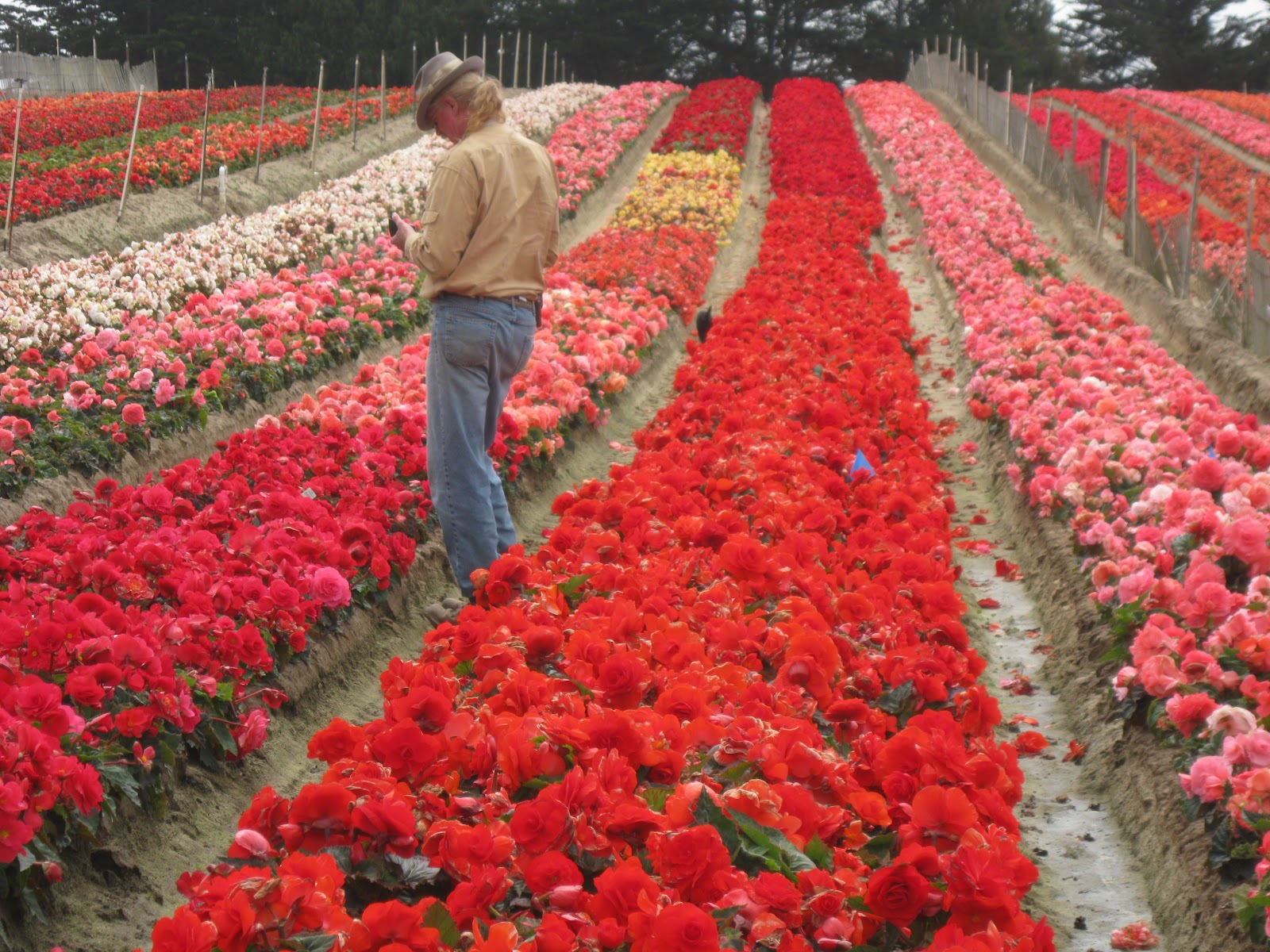
Below is a shot of cross #12012200. A pink roseform. Notice the high percent of fully double flowers and how they are presented on top of the plant.  This looks like it may be a good cross!


Using these techniques, Golden State Bulb Growers has been able to produce products unique on the world market.  Our lace begonia series, a reverse picotee, is not available from other begonia breeders.  As a result, we sell seed of this series to large begonia tuber producers in Europe.  In fact, European begonia producers produce more tubers of this series than we do here in the States, all from seed we sold to them.


Red  Lace on our porch

Appricot Lace, GSBG  Photo

Our Daffodil Begonia is an old type first noted as a mutant variety in 1896, we have kept this type in breeding and in production and have made improvements.  It is considered very rare.  J. Haegeman in his book Tuberous Begonias notes them as being variously named “B. Tubereauz a fleur de narcisse”, “Daffodil-flowered begonia”, “B. narcissiflora” and several other names.  He finishes the chapter on this begonia by writing “As this group is no longer found in commerce, any discussion of its name has only a theoretical value.”  Well, it is still in commerce and we are the only ones to have it.  It is, in my opinion, a product for a collector not for the person who likes an easy to grow large flowered begonia.


Salmon Daffodil GSBG Photo


Breeding programs are expensive and their pay back is very long.  Sales of the product have to support the program.  When sales are slow, the breeding is the first thing to be limited.

-Andy Snow