Showing posts with label Brown Bulb Ranch. Show all posts

Saturday, January 26, 2013

Tuberous Begonias, Color Photos by Ansel Adams


“The Mockingbird Flower”


September 19, 1950 Life Magazine.


The text reads: U.S BREEDERS GLAMORIZE ONCE HOMELY BEGONIA When Charles Plumier, the French botanist, came upon a strange new flower in the West Indies about 1690, he named it for Santo Domingo’s Governor Michel Begon and took home a specimen.  The begonia was interesting botanically, but it was not very striking: its blooms were small, nondescript and dwarfed by the plant’s jagged leaves.  European horticulturists improved on the tuberous begonia’s looks, but after 200 years it was still a rather plain-looking flower.  About 1920, however, U.S. flower growers became interested in Plumier’s plant and began crossbreeding on a big scale. In 30 years they have transformed the begonia as no other flower has ever been changed so short a time.  The little wildflower has been turned into one of the most spectacular.  Hundreds of new varieties have been created, some bright solid colors, some specked, dome with frills and beards.  Their lush blossoms are often a foot in diameter.  All the begonias on these pages (except the one at the right) are new American types, developed principally in California at the Brown Bulb Ranch and Vetterle and Reinelt farm, which together produce more that 90% of U.S. begonias.  These firms have developed so many new strains, some resembling such well-known flowers as the camellia, rose and carnation the begonia is now referred to as the “mockingbird flower.”


Here in the West we value Ansel Adams, and his photos, very highly.  His black and white photos of our mountains and wild places had a huge influence on our view of wild places and the development of park systems to (ideally) protect them.

The fact is that Ansel Adams took in a lot of “commercial” work to pay the bills.  He was highly regarded as a commercial photographer and the glorious art prints we have come to associate with him did not pay the bills until later in his life.

He wrote to his friend David McAlpin as early as 1938, “I have to do something in the relatively near future to regain the right track in photography. I am literally swamped with “commercial” work — necessary for practical reasons, but very restraining to my creative work.”

As some of you know by now, I work as the begonia breeder for Golden State Bulb Growers, a company that used to be known as the Brown Bulb Ranch.  The Brown Bulb Ranch was located in Capitolia, California, and in 1950 was being run by Worth Brown, son of founder, James Brown.  When Life magazine commissioned this article on begonias, they hired Ansel Adams to do the photography.

During this photo shoot of the Capitola begonias for Life Magazine, Mr. Adams stayed in the adobe house of Worth and Jane Brown at the Brown Bulb Ranch.   Barclay Brown, son of Worth and Jane,(and my father-in-law) remembers Ansel Adam's visit clearly, Barclay talked to my wife and me about it at dinner the other day.  Barclay would have been around 18 at the time.  Worth and Jane reminisced, when they were alive, about the visit of Mr. Adams.  By the time of his visit, he was well known and Worth and Jane were active in society and interested in art and, I imagine, pleased to be hosting so eminent an artist.. Barclay told us Mr. Adams played the piano after dinner.  Mr. Adams taught himself to play the piano at the age of twelve. He was an accomplished pianio player and music was, at first, his intended occupation.


 I was surprised when I first saw these photos many years ago at the Brown Bulb Ranch because I did not realize that Ansel Adams had any color photos in circulation.

I hope you enjoy these photos as much as I do. 


The text reads: “A Flood of Flowers fills the greenhouse at the farm of Vetterle and Reinelt at Capitola, Calif.  Most of them are standard tuberous begonias, of all shades and colors, but at the top of greenhouse are hanging basket begonias, which are just coming into popularity.  Begonias can be grown either from seed or from tubers. To get them to produce seed they must be hand-pollinated.  Bees and insects do not do a very dependable job of fertilization, possibly because the begonias have little or no fragrance.  Their season, which began in May, will last another few weeks.  One big asset of begonias is that they are comparatively free from plant diseases."


The Text Reads: "A Fiery Guard over a field of begonias is this oil heater on stilts, which sends out infrared radiation to protect an acre of flowers or vegetables against frost.  Begonias generally fare best in moderate climate like that of California, but hardier species are being developed to withstand a wider temperature range."


  Ansel Adams even took some photos of Worth and Jane and their sons Barclay and Todd during his visit.  We found the photos in an old album that belonged to Worth and Jane.


Notation says "1949 taken by Ansel Adams" Worth Brown on the left and family portrait on the right.

 I want to leave you with my favorite Ansel Adams photo.  Moonrise, Hernandez New Mexico.   Although I like the photos he took of  wild places, I really like this one because it's both wild, lonely and inhabitable.


Best Regards -Andy

Saturday, January 19, 2013

Degrees of Good

Or: Up from industry.. to what?

“The best is the enemy of the good.” Voltaire

What Voltaire meant by this famous quote is that we often sacrifice what’s right, fine and, good to try for something that’s maybe just a little better. 

I know several people that are excellent in their chosen field.  Excellent martial artist, excellent musician.  The thing is, their lives are all screwed up.  Because life is about balance, not extremes. Excellent is extreme.

I am a believer in moderation in all things. Of course you have to include moderation in that equation too.  I mean come on, don’t take your moderation to an extreme. Get excited about something.  Play music ‘till late at night once in a while. Prune your front hedge to look like circus animals and dinosaurs. Or whatever.

What does this have to do with begonias?  Why does it always have to be about begonias?

I’ll tell you.

Judith Taylor in her article, The Begonia in California wrote “The Brown Bulb Ranch grew tuberous begonias on an industrial scale in Capitola for many years. The firm saw the possibilities in the mass market and grew millions of plants each year”

I don’t know about you, but it kind of makes me feel like we’re Folgers coffee or Budweiser Beer. 

 We’re better than that, maybe not excellent, but good, we were back then and we are more so now.

It is a fact that we have based our business, whether begonia or calla, on seed.  Our company was very involved in developing true seed strains of tuberous begonias (our company history says we ARE the developers of lines that are true for color)  Previous to true lines, all tuberous begonia hybrids were vegetatively propagated and very expensive.  Seed lines enabled us to bring the price of tuberous begonias down and produce millions for the market place.  That’s good, maybe it’s not excellent, but is it industrial?

 My job is to breed seed lines that are as good as I can make them.  But the fact is that all seed lines are kind of a crap shoot (except true F1s).  The genes recombine and the dice roll.  I have some lines in which every male bloom is a solid multi-petaled double.  Others, well, not so much.  I look at all our 54 varieties and decide which are the weakest. Then for a few years, we work on those and improve them.

The only other successful seed grown begonia is the Non-Stop.  A popular begonia with smaller flowers suited to garden beds and, so I am told, very popular as cemetery plantings in Europe.  In parts of Canada, Non-Stop is synonymous with tuberous begonia; like Kleenex is synonymous with face tissue, (again something I’ve been told).

Our equivalent to the Non-Stop is the On-Top. Get it? Non-Stop, On-Top.  The difference is ours are all bi-color or picotee because, at the time, we didn’t want to go head-to-head with Non Stops in the market place (they were too cheap).  Now they have picotees too, so it goes.

But our “standard” begonia is the large flowering “exhibition” type begonias (and hanging baskets).  You know, the spectacular ones.

Among the large flowered begonias there are degrees of good.  (And that’s only if we all agree on what’s desired in the realm of floral beauty, other opinions are welcome.)

Our seed lines knocked the socks off of Antonelli's seed lines.  I know, I grew Antonelli's begonias.  They brought me their seed and I returned to them tubers.  They had their own mother stock and genetics.  From their mother stock they took cuttings.   They called them Antonelli’s Champions.  They were all identical.  The best they had (we have those plants now).

Antonelli's Champions.  Notice my highlighter over the size. "1 inch (sometimes smaller)"! Holly smokes!


Blackmore and Langdon.  Great begonias. There's a mark for us to shoot at.  We could pick on them for this or that, I don’t like the fact that some have weak stems and don’t hold up the flowers very well.  But then again, the flowers are often huge.  Vegetatively propagated.  Expensive.

In some ways, cloning begonias is easier, you only have to find one good one.

The breeding may be easier but the production is harder and therefore, more expensive.

We vegetatively propagate only our Scented Begonias.

We used to have a program of named varieties that we (inside the company) called “Stake Stock” that were selected (staked) while the plants were in bloom and then hand dug before the Green Monster went through the field.  I’ve tried to reinstitute that program a couple time, with no success.  The sales department didn’t sell them, the warehouse crew threw them out and when  I sent a couple of the tubers to Paul Carlisle and I saw them in his greenhouse, I was not impressed with the results.  We will have to improve our performance if we want reinvigorate that program.  Next year, I will make the selections myself.

"Stake Stock" in our 1978 Catalog

Cover from the catalog above


But, let’s run the numbers.  Let’s say 5% are junk, 90% are good and 5% are excellent (or maybe it’s 10%-80%-10% or  20%-60%-20% whatever).  Do you want to pay me to find the 5% for you and charge you for that, or do you just want to buy a few tubers for the same price as the one I selected and take your chances?  You might get the junk, you’ll likely get the good and you might get the great.  The collection of begonias that you decide to keep will reflect your taste, not mine.

So, the question is, and why I started writing all this about three pages ago is this; I am wondering if we should start a vegetatively propagated begonia program for more than just Scented Begonias?  It’ll be two years before the first ones could come along.

Should we have three degrees of good;  the Clones, the Stake Stock and the Seed Lines?

Could we become less “Industrial” would we become “boutique”?  Or is that just one more way to lose money?

Other news and note in our tuberous begonia world.  Paul Carlisle and his lovely wife Laurel had a great article in the “Begonian”, which is the magazine of the American Begonia Society.  Great article, great photos and a wonderful cover shot by Gary Hunt.


For more of photos of Paul’s begonias by Gary Hunt clink here.

For an article I wrote about Paul click here.


-Andy

Tuesday, September 18, 2012

What's in a Name


Wholesale vs Retail

Among the many varied tasks I was assigned during my first year working for the Brown Bulb Ranch was covering our logo on shipping boxes.  All our boxes had, reasonably enough, our logo.   We had spray paint that was exactly the color of new cardboard and I would turn our logo boxes into generic boxes. 

This puzzled me at the time.  Wouldn’t we want the recipient of the boxes to know where the begonias came from?   I was informed that, no we did not. 

You see, our customer was a wholesale buyer who sold to the person to whom we were shipping, and our customer (the wholesaler) did not want the recipient to know where the begonias came from.  In that way the wholesaler (our customer) insured that his customer (the recipient) would have to come back to him if he wanted more of those wonderful begonias, he wouldn’t know where else to go.

These days what is called “Branding” is a big deal.  It’s such a big deal that people will pay more for a particular Brand even if there is no inherent value other than the name. T-shirts, shoes, whatever. A maker of tablet computers, for example, is able to demand four times what other tablets sell for because of their brand name. 

But that was not the original purpose of a Brand. Branding is supposed to be an assurance of quality, a “Name”, a reputation you could count on.

Because we considered ourselves to be wholesale and not retail, we were happy to support whomever was selling our product by making them seem like the Big Deal, the Producer, the Great Garden Provider, the Brand Name.    White Flower Farm had our Lace begonias on the cover of their catalog one year (wish I could find it, it’s just here somewhere) where inside we were called “Our California Grower”.  Being anonymous was a customer service.

But, hey!  They sold our begonias; as did Jackson and Perkins, David’s and Royston, Burpie and dozens of others, both high-end, middle of the road and Michigan Bulb.   We were stealth samurai begonia growers.  Egoless and free of the hordes of tourist that were clogging up the greenhouses of Vetterle and Antonelli with their picnics, weddings, and endless photographs.


Vetterle and Reinelt's "Cathedral of Begonias" Photographer Unknown


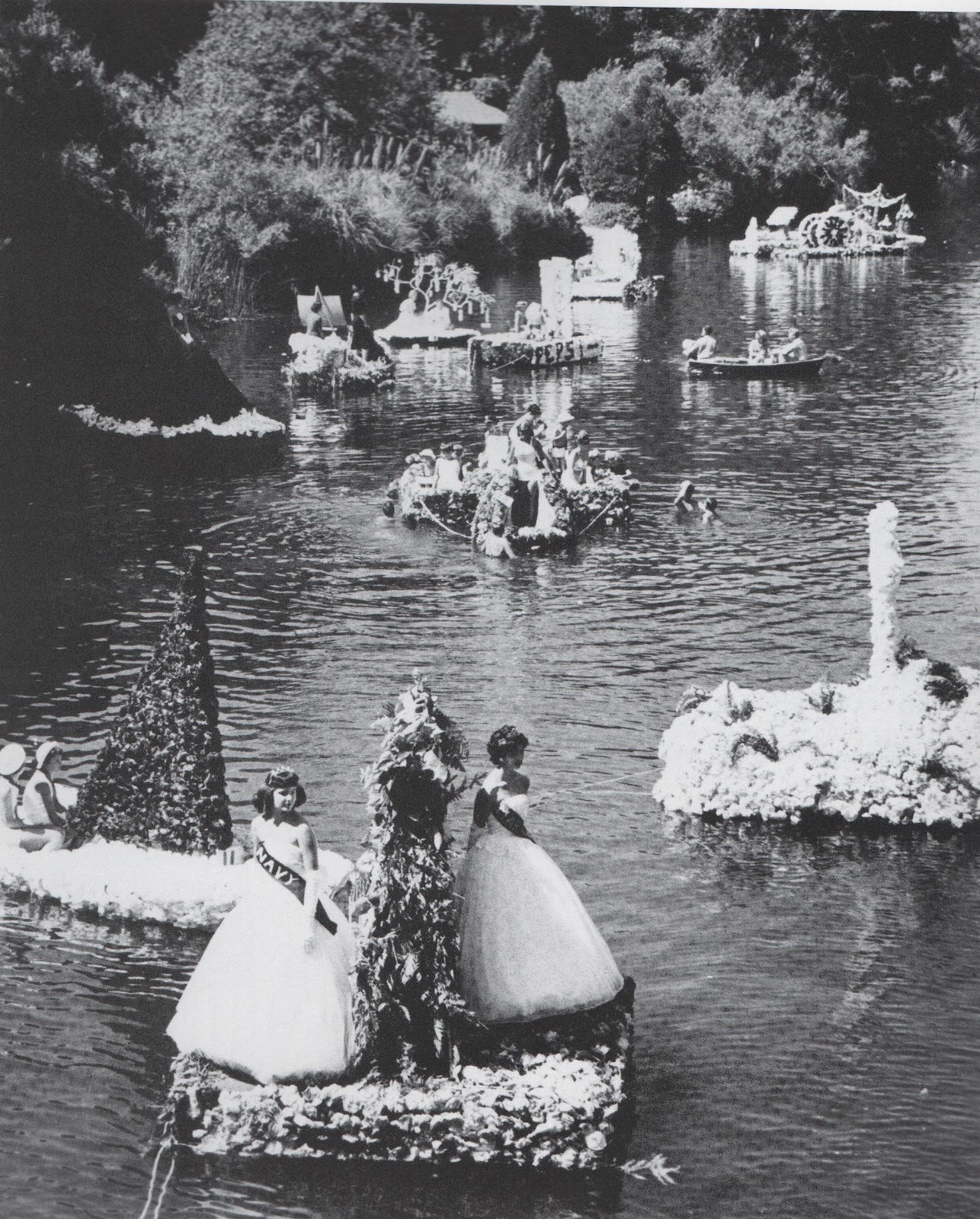
I used to live in Capitola, on the Old Ranch, and I would walk down to the Begonia Festival every September wearing my Brown Bulb Ranch hat.  Nobody knew who we were.  All the floats in the Nautical Parade are covered with begonias that we provided and nobody knew (these days the organizers are much better at giving us credit than they did then). 

If I mentioned to someone that I grew begonias for a living they would remark “You must work for Antonelli’s” 

“No, I work for Brown’s.”

 Blank look.  Followed by “Who?”


Capitola Begonia Festival 1959. 


Capitola begonia festival Floats2012 Photographer unknown
Capitola Begonia festival float 2012 Photographer unknown

Garden catalogs have pretty much gone away.  We are still a wholesale provider but most of our product goes to the professional grower, not the home gardener.  The professional grower is serviced by a “plant broker”.   The broker is now our customer.  Begonias don’t work very well for industrialized greenhouse operations.  Callas do. Where does that leave our begonia business? 

Needing to modernize you say?

Well, we are trying.  A few years ago we registered a brand name; The Amerihybrid® Begonia (ask for it by name! Accept no subsitute! Tell ‘em Andy sent you!)

Now, you have to admit that our begonia strategy was not without merit.  Of the four families that grew begonias around Capitola, we are the only ones still in business and still growing begonias (even if it is only 30% of what we grew in our heyday.)

Modernize.  These days that means the internet, right. 

There are things you can buy and things you can’t.  Reputation is not something you can buy.  Names however, you sometimes can.  

Antonelli Brothers produced about 3 acres of begonias, I know, I grew them.  We had about 30 acres.  Antonelli Brothers’ annual begonia sales revenue in the year before they closed was about the same as ours for the same year.  I don’t know about you, but that says something to me about the margins inherent in retail versus wholesale.  

Antonelli’s was a three generation family business.  When they were in Capitolia, the tour busses pulled up to their place during the bloom season. A visit to the beach at Capitolia-by-the-Sea was not complete without a visit to the famous Antonelli Begonia Gardens.  They were a Name.


Antonelli's 2009 Catalog.  The last one.


Golden State Bulb Growers now owns all of Antonelli’s begonia mother stock, we own what seed they had on hand when they decided to throw in the towel and some seed we have collected since.  We are, for all intents and purposes, Antonelli Begonias for the 21st century. 

Maybe that should be our retail brand.  What do you old time (no insult intended) begonia growers think?  Does the name “Antonelli Begonias” still have any cachet?  And if so, should we exploit it?

Retail is supposed to be customer centric.  That’s why retail gets the big markup, to pay for sales and customer support staff.  Wholesale is production centric, we rely on wholesale buyers and brokers to be our sales team and our customer support, that’s why they get to clip the ticket.  Golden State Bulb Growers is a very experienced production grower.  Servicing retail customers is not something we have much experience with… yet.  There is a lot of inertia around here and it is going to take a while to change.  But change is in the air.

Geez this sales stuff baffles me.   I’m gonna go make a few female begonia flowers pregnant. 

-Andy


Antonelli Begonia Gardens in the 60s.  Photographer Unknown


Antonelli Begonia Gardens Capitola California.  Photographer Unknown


Sunday, September 9, 2012

Paul Carlisle


Meet Paul Carlisle.

If you like tuberous begonias you should see what this guy does with them.

Paul is a begonia grower extraordinaire.  He knows all his tubers and their history.  He has an incredible way with his plants.

I first met Paul at the American Begonia Society convention in San Francisco in 2010.  We had talked on the phone a couple of times before the event and he invited me up to speak to the convention.  I liked him right off and we have kept in touch ever since.

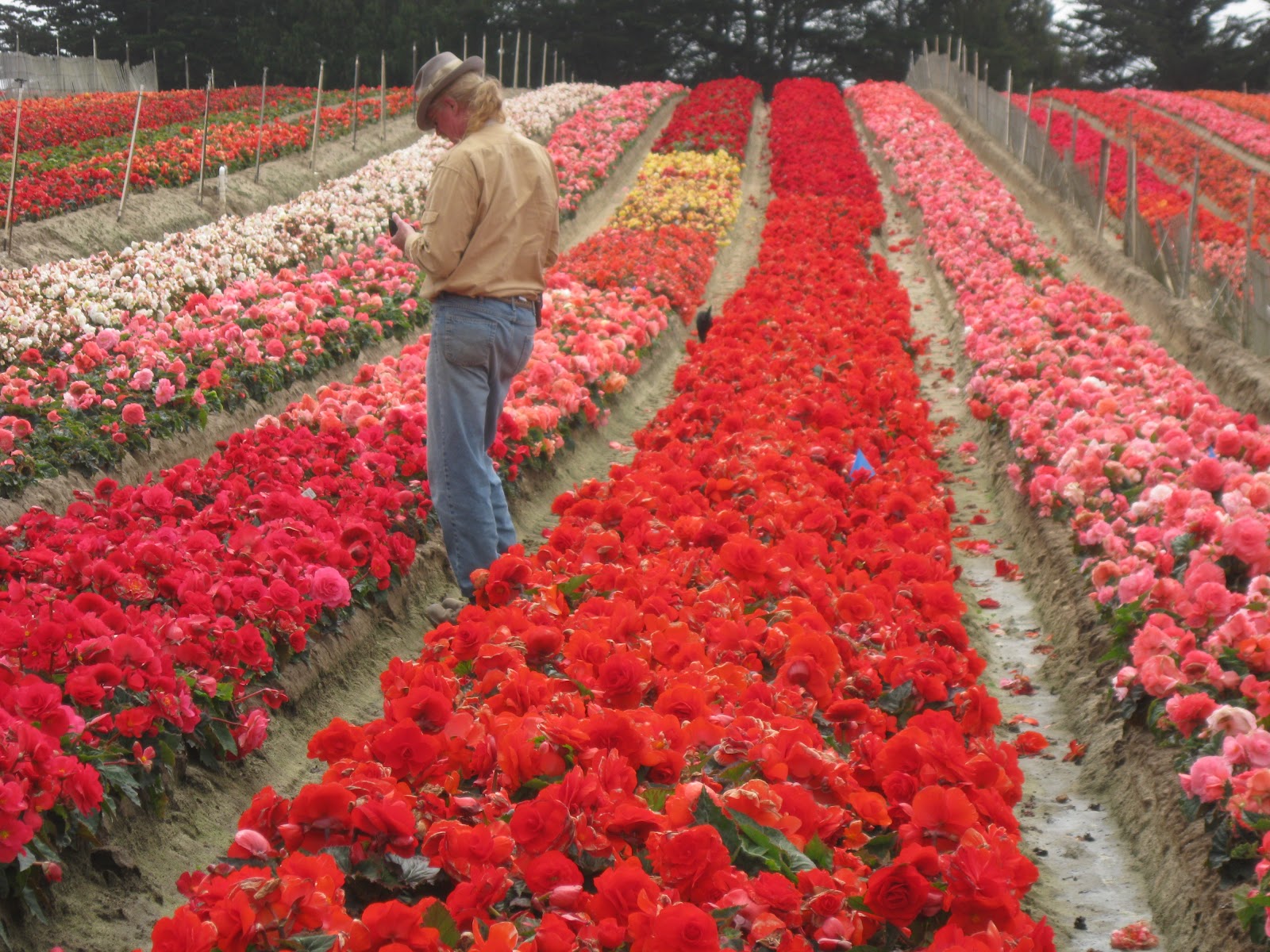
It was Paul who sent me the book I reviewed in a previous post.   Paul readily admits that he likes the BIG flowered begonias and he knows how to achieve these though his careful management of the plants.  For example; he always picks off the first couple of blooms to allow the plant to get larger before developing bloom, and there wasn’t a female flower to be seen on any of his upright pots.

This year he fed with a  low Nitrogen fertilizer as the flowers were developing and was happy with the results

We visited him a couple weeks ago when Paul invited my wife, my son and me down to have lunch with him and his wife, Laurel
Let’s let take a look at what we found:


                          Stepping off the back porch, this is what you find


Fiona, full sibling to Fairy light by THAT English begonia company (Blackmore and Langdon)


That's me on the left and Paul Carlisle on the right.

One of many benches in Paul's shade house

Lola among the begonias
 Falstaff by that English Begonia company again.

He came to visit me today and we went out to the begonia fields and I was able to repay him by shouting for lunch at Sea Harvest in Moss Landing

He and his lovely wife have been growing begonias since the late 70’s (so, let’s see, that means he has been growing begonia longer them me –gasp!)  He started showing at County Fairs.

We have such a different eye to begonias he and I.  Because he grows the winners, he can spot the potential prize winner looking across a field (he dug a few I hope do well for him). Because I grow my seed crosses looking for the highest percent of good doubles, I only see the losers. 

Paul’s a stand up guy with a good since of humor and a breezy nature, we need more like him.  He’s the ambassador of begonias.

For more of pictures of his begonias see the posting here (this is a blog I need to catch up on with incredible photos, and they beat me to the punch with their scoop on Paul and their great Paul Carlisle begonia pictures)


Wednesday, August 15, 2012

Begonia Breeding at Golden State Bulb Growers

Warning, this post contains a lengthy description of our begonia breeding program, I am afraid it will be terribly boring for the general reader (and maybe everyone else too).

When I became the begonia breeder for Golden State Bulb Growers (at that time the Brown Bulb Ranch) the Begonia x Tuberhybrida was already a well established product with a world wide market.  Tuberous begonias were among the first begonia species to be hybridized. 

I am happy to give a history of tuberous begonia breeding, but I am sure that information is available elsewhere.

Although I have messed around with species begonias, my real work has always been within the established hybrids. 

Growing tuberous begonias from seed for tubers is our business, and it has an inherent problem that the vegetative producer does not face.  Our goal is perfectly formed, large male flower (It is the male flower that is so showy).  The ideal flower is, however, sterile.  So, we must keep some imperfect flowering plants around to provide pollen.  Pollen is our most precious commodity, not seed.  Give me good pollen, I will produce enough good seed.  Good pollen comes late, or some years, not at all.  A plant that will contribute it’s pollen but not its characteristic for imperfect flowers in rare.  The resulting crosses are therefore not entirely uniformly perfect.  I strive, as a breeder to keep the percentages of good double flowers high, in some types it approaches 100%, other types; not so much.

In a previous post, I showed an old photo of myself and Todd Brown grading crosses in Marina. 

We used these crosses to evaluate our mother stock.  We would take the pollen from one pollen plant (called a “sire”) and put it on a specific seed parent (called a “dam”) we would hang a little paper tag on the pod that received the pollen with both parent’s numbers.  In this way we could grade the mother stock by looking at the crosses.  We would, for example, look at a series of plantings where the only difference was the sire, same dam.  We could then deduce that any variation in the population was due to the sire.  Also, if all the crosses were bad, we could deduce that the sire was not so good.  Same was done where the sire was the same, different dams, same deductive procedure.  We graded for both flowers and plant form because we are always looking for crosses that present the bloom well. We also brought in unique individuals we found for future mother stock.   

In this way we rated our mother stock plants from A to C with plus and minus, making 10 grades.  We wrote out a score card for each plant that stayed with the tuber.  This score card would record how it performed in crosses, how reliable the pollen production is (if a sire) and other characteristics .  Every year we rewrote the score card adding that years information.  With over 6,000 mother stock writing the cards was a big job.  Every year we discarded the mother stock that got the worse grades and added pots from our previous years selections.

 Below you see a picture of me making crosses in the 80s, the score cards are clearly visible in the photo.  The thing around my neck is a metal holder that contains a rectangular piece of glass that has been painted black on the back side, this was used for collecting pollen that was applied to the female flower (begonias being monoecious) using a small brush.


We would arrange the mother stock pots on the bench by type, then by the grade of the individual.  For example, the first pot on the bench would be the highest graded sire, the next one the second graded sire etc. After the sires came the dams, highest rated first.  We would also cut our highest rated parents.  This arranging was done so that the pollinator would take all the available pollen from the highest rated sire and only after that was exhausted, go to the second highest rated.  Conversely, if only a small amount of pollen was available, it would go on the highest rated dam.  All female flowers had to be pollinated or picked so that no dud pods would be processed.  When we pollinate a flower, we nick a petal with our fingernails to show the work is done and not waste additional pollen on that flower again.

After a few years, it became obvious that a better solution was to find the one best cross, whatever the parents, and make that cross over and over again until a better one could be found.  This was achieved by actively cutting the best parents until we had enough pollen and seed parents to supply all the seed we needed.  Recently, we have been able to do this with tissue culture. This is easier said than done, some individual begonias just do not take well from cuttings, unless you take a bit of tuber with the cutting, I don’t know why.  The same ones that don’t cut well, don’t tissue culture well. (If anyone reading this has a good cutting protocol, can you please share it in the comments.)

The only danger in this improvement in our seed production, is that it is tempting to discard mother stock plants that are not, anymore, being used for production.  There is an economic incentive to keep the mother stock as lean as possible.  We therefore risk losing genetic diversity.  We keep old seed and seed from past crosses as well as a good selection of non-productive plants for this reason.

Plant breeders sometimes use inbreeding as a technique and Worth Brown mentions using this tool with begonias, in his book “Tuberous Begonias” published in 1948.  We also use inbreeding to get new types and make improvements in existing types.  Begonias do not take well to being inbred and the breeder soon loses germination and vigor.  However, it is much easier to get that one characteristic your looking for. You can inbreed either by putting the plants pollen on it’s own female flowers called a “self” on the another individual with the exact same parents called a “sib” (short for sibling). 

In order to pull this program off, you have to have two lines going with the characteristic you want.  The two lines are not related.  When both lines come true, no mater how weak they seem, you can re-combine the two lines and get back the hybrid vigor that you lost during inbreeding.  Sometime times further work is needed past the F1 stage to make a fully marketable plant.

Using this technique, we were able to develop the On Top® line within a relatively short time.

On Top Sunset, GSBG Photo

Because we have been breeding with our own material so much, I am always on the look-out for new material.  In the past I have traded seed with Australian begonia breeders.   Recently, Antonelli Brothers, a long time begonia breeder with which we have had a long relationship, went out of business and we were able to acquire their mother stock; a beautiful collection of plants that gives us lots of opportunity to combine the two lines and make something better than either one on it’s own.

All plant breeders must make compromises. The plant breeder must make decisions about what one or two characteristics he values most and must make his selections based on those criteria.  As it often happens, those traits he, or his superiors, don’t value are the traits that sometimes haunt him later. 

I was taught to always breed with the plant in mind, not to make decisions on which hybrid is better based on it’s ability to produce large tubers. This is true despite the fact that we are a bulb company and charge according to tuber size. Big tubers make us money.  Some of our crosses, like the Dark Leaf Red are horrible tuber sizers, I would be doing my company a favor if I could improve it’s ability to make larger tubers.


Dark Leaf Red Tuberous Begonia


Other companies do select for bulb size. It’s kind of a running joke in Belgium that the breeder goes thorough the bulb trays, in the storage shed after harvest, and picks the largest tubers for his breeding/production program.  Maybe it’s just a joke but I’ve heard it from several places.


Below you see a me grading crosses at the Manresa ranch in La Selva Beach a couple years ago.  I am making notes on a little Palm thing.  The stick under my arm is to enable me to reach across the bed and tip a flower so I can see it.


Below you see me, yesterday (8/14/12), looking at this year's crosses.  Same Palm thing, I gotta get a new hat.


Below is a shot of cross #12012200. A pink roseform. Notice the high percent of fully double flowers and how they are presented on top of the plant.  This looks like it may be a good cross!


Using these techniques, Golden State Bulb Growers has been able to produce products unique on the world market.  Our lace begonia series, a reverse picotee, is not available from other begonia breeders.  As a result, we sell seed of this series to large begonia tuber producers in Europe.  In fact, European begonia producers produce more tubers of this series than we do here in the States, all from seed we sold to them.


Red  Lace on our porch

Appricot Lace, GSBG  Photo

Our Daffodil Begonia is an old type first noted as a mutant variety in 1896, we have kept this type in breeding and in production and have made improvements.  It is considered very rare.  J. Haegeman in his book Tuberous Begonias notes them as being variously named “B. Tubereauz a fleur de narcisse”, “Daffodil-flowered begonia”, “B. narcissiflora” and several other names.  He finishes the chapter on this begonia by writing “As this group is no longer found in commerce, any discussion of its name has only a theoretical value.”  Well, it is still in commerce and we are the only ones to have it.  It is, in my opinion, a product for a collector not for the person who likes an easy to grow large flowered begonia.


Salmon Daffodil GSBG Photo


Breeding programs are expensive and their pay back is very long.  Sales of the product have to support the program.  When sales are slow, the breeding is the first thing to be limited.

-Andy Snow

Thursday, July 19, 2012

Breeding Scent in Tuberous Begonias

A Little History


Happiness is a scented begonia

"The Gift of perfume to a flower is a special grace like genius or like beauty, and never becomes common or cheap." John Burroughs

Breeding scent in tuberous begonias, and getting those begonias to market, has been both a real challenge and a real pleasure.

Some of the original species used in the development of the tuberous begonia had scent (B. cinnabarina ,B. baumannii,  B. foliosa var.miniata,  B.fimbristapula,  B.capensis and B. fimbristapula) . 

There have always been a very few tuberous begonias that showed a faint scent among the general population, and there were even a few that made it to the public. 

B. Baumannii is the most fragrant species and after being discovered in 1891 was crossed on tuberous hybrids immediatly.  B. "Tiges de fer odorants" was brought out in 1892 by the the breeder Limone.  Various scented begonias followed by the same breeder using this species and tuberous hybrids.

 Our company marketed a scented begonia in 1939 called “Fragrance” that was a cross selected from among 50,000 seedlings obtained by crossing B. baumannii and tuberous hybrids.

Leslie Woodriff, the famous breeder known for originating the “Star Gazer” lily, made many crosses in an effort to produce fragrant tuberous begonias in the 40s and 50s, with some success.  He crossed B. Baumannii with regular hanging basket begonias and something called “species #1041 from the University of California”.  Mr. Woodriff produced a single called “Orange Sweety”.  He also produced scented begonias he named “Patty’s Sweet” and “Yellow Sweety”.   "Yellow Sweety" has had a long life among begonia growers.


Zak and #77KL (Scentiment Sunrise)


Rather than going back to a species begonia to obtain scent we have worked within Begonia x Tuberhybridia. That is why the flowers of our scented begonias are still the fully double flowers that we have come to expect.  There was a mistaken impression among the early breeders that it was the pollen that caused the scent.

About 1986 our company was contacted by Howard Siebold who, for 50 years, bred tuberous begonias, for scent, as a hobby.  Since we had a similar interest, I  began working with Mr. Siebold and exchanged plant material with him.  Golden State Bulb Growers bought the patents on two of Mr. Siebold’s tuberous begonias, Golden Anniversary and Sweet Dian.   Mr. Siebold just wanted to see scent returned to the magnificent flowers of tuberous begonias.  He had been working with crosses made from B. Yellow Sweetie. 

I think Mr. Seibold really wanted the names of his begonias to enter the market place.  They meant something to him.  He was very disappointed to find that a salesman will change any name to another if he thinks it will sell better.  Mr. Seibold’s Golden Anniversary was sold by Jackson and Perkins as “Nectarine Rose”.

While Mr. Siebold was an enthusiastic hobbyist, he did not have the facilities that we, at Golden State Bulb Growers, have for plant breeding.  He only had a small outdoor growing area to evaluate his crosses.  We have agricultural fields.

Mr. Siebold would send me his most promising crosses which I would plant out for him along with our breeding material in the fields in Marina.  He would come down from Fort Bragg once or twice a year and go through the crosses.  The scent in those early crosses was so rare that we would spend hours on our hands and knees smelling for the slightest scent.  Any that he wanted would be staked with a flag of a certain color and I would send them up to him after harvest.  Any he didn’t want were mine! 

We worked together for some years, and I can say for my part, that I enjoyed our relationship.  Unfortunately, Mr. Siebold passed away many years ago. 
When he died he gave many of this begonia tubers to me, including some B. Yellow Sweety and B. Love Song, and the rest went to the Strybing Arboretum. 

He did have one annoying habit though.  He would send seed from one of his scented crosses to anyone who asked! 

Every time another begonia breeder comes up with a scented begonia, I remember those little seed packets going all over the world.

And doesn’t it just frost me every time some begonia salesman comes up with “the first scented tuberous begonia in the world”  The patents for Golden Anniversary and Sweet Dian were in the late 1980s, and “Fragrance” was found way back in 1939. And then there were Leslie Woodriff’s fragrant begonias and don't forget Lemoine's crosses in 1891.

Breeding for scent and finding the right plant within a field of flowers, is only half the battle.  Because the fragrance is so elusive, it is necessary to clone the plants.  Tissue culture of begonias, while relatively straight forward, is still tricky.  Things can go wrong at the last moment, just before planting out to the greenhouse. 

In the past, we have worked with several commercial  tissue culture labs with only limited success.  For example, we have ordered 30,000 clones only to be delivered 2,000 of which half would fail when removed from the tissue culture vessel!  This just drove our sales guys crazy.  A lot of our sales were through garden catalogs (remember garden catalogs?) and if the customer had printed his catalog, (at great expense) he would not be happy when we failed to supply, or supplied 300 when he ordered 5,000.  We have always been a wholesale operation, and having less than a thousand of anything sometimes slips off the radar. 

We have our own lab now but still have problems.  Some years we get lots of one sort, the next year lots of different sort the third year very little of anything. 

Some years we have one or two thousand, some years a couple of hundred, it’s frustrating.

I saw in a White Flower catalog once a Blackmore and Langdon scented begonia for $140 per tuber!

When something is rare, it is more valuable.

The fragrant begonia is an item that fits the retail / internet model of marketing better than the catalog/ wholesale model. On the internet we can sell what we have and that’s that. No upset middleman.

Golden State Bulb Growers hold 8 patents on scented begonias, two with Mr. Seibold as inventor and 6 with my name on them. Golden State Bulb Growers has trademarked the term Scentiment® for them.   The 4 newest patents are much improved over the 4 original (including Mr. Seibold’s 2 original).  There are fifteen more candidates for patenting being evaluated.

Scent is a funny thing.  Give different people a scented flower and they all smell something different. “Smells like honey” , “Smells like Fruitloops cereal”, “Smells like apricots” “Smells like Lemon Pledge!” all from the same plant!

The other thing with scent is that your nose soon looses the ability to discriminate the subtle differences in fragrance.  I have learned a trick from the perfume industry.  It is to take a few coffee beans and put them in a baby food jar and whenever my nose starts to burn out, I’d give the jar a shake and open it up, take a whiff, wipe the slate clean and start again.

The scent in begonias is not overwhelming.  It is not like jasmine, gardenia, or narcissus.  It is subtle.  The scent is produced by a volatile oil and it is most noticeable as the day warms up, at the end of a long hot day there is not much scent left.   In the greenhouse it is very noticeable, getting out of the truck among a field of them is quite heady.

One time Justin Brown and I were going through the scented begonias in the greenhouse, trying to decide if they were worth keeping or not.  We were going down the benches, plant to plant, smelling the flowers, passing the nice ones back and forth. “Um, this one’s nice, try it”.  At the time a greenhouse worker, a young man, was going along and watering dry pots.  When he got to us he remarked “Tough job, eh?”  Well, yes it might just look like the ideal job.  Smelling the flowers.

I don’t think they’ve ever made us a dime.

#77KK Called "Scentiment Bulsh Pink"


#77KL Called "Scentiment Sunrise"