Showing posts with label Begonias in the Mist. Show all posts

Monday, December 24, 2012

The Green Monster and a 5 foot Horizontal Blue Flame


Or Here We Go Again!

It’s tough this time of year. I never liked winter, that’s why I moved to California forty years ago, but there’s always winter, isn’t there? 

The days short, I go to work in the dark and return home in the dark, morning and evening chores are done in the dark.  Moods are dark, the weather dismal.

I was so happy last Friday when at 3:12 am we finally turned the corner and our half of the planet started to turn toward the sun instead of away from it.   Better days are ahead.

It is at this time of no-flowers-anywhere that we dig our begonia crop.  It’s the busy season, the soil and sky dark, wet, and heavy.  Dark, wet and busy, the joy of this season evades me. 

As I write this piece, two days before Christmas, the rain is bucketing down and has been for days. 

The begonias were happily going to sleep in their wet soil, maybe they would have died there, maybe they would have risen next summer and been a glory again, but they are saved from whatever their fate might have been now that they are meeting the Green Monster. When its time has come, The Green Monster is called out. The Green Monster stops only for dark- not rain, not mud. 


The Green Monster
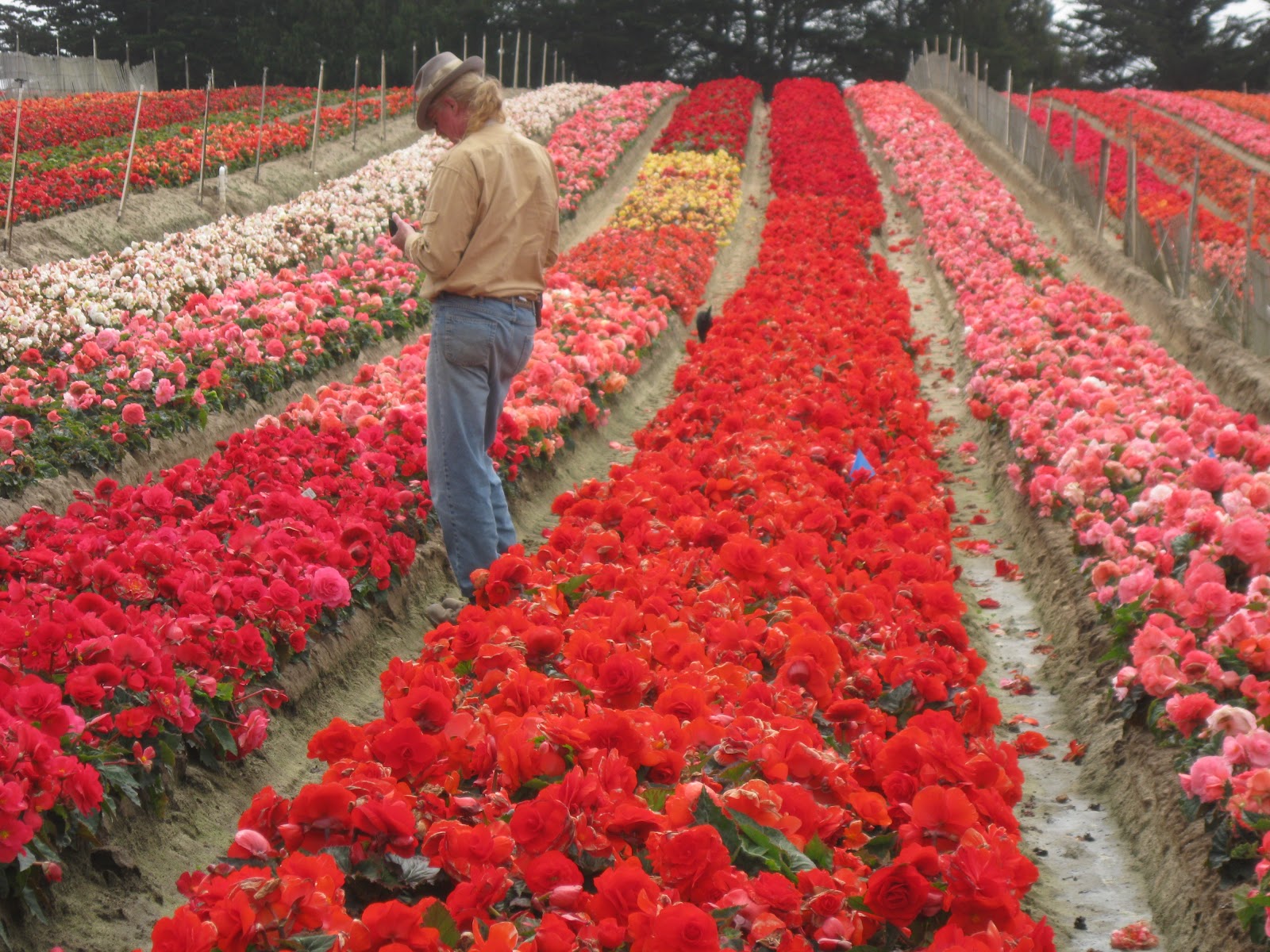
The Green Monster, surrounded by his attendants, moves through the begonia fields


An old piece of agricultural equipment, the Green Monster is not used for any other purpose than to unearth begonia tubers.  The Green Monster is a modified potato digger; the blade passes under the tubers and they are lifted onto a broad chain that jumps a little on a small cam to shake some of the sand off. Then the lumps of soil are unceremoniously dumped into a bin, each with it’s tuber inside, and transported to Moss Landing, where most of the remaining soil is washed off and the begonias are dried, sorted and sold.

The washer dumps lots of recirculated water on the tubers, two settling ponds collect the Marina sand that gets hauled away in summer. And there’s the dryer.  Oh, the dryer.  The dryer is 3 standard shipping containers placed side by side and cut so that a hot wind driven down the center container is divided and driven back up the outer two.  The begonias, wet after being washed, are stacked on pallets and are subjected to this hot wind.

Many years ago the Brown Bulb Ranch dried apple pulp.  There were several companies around here that pressed apple cider and the pulp was recycled, after drying, to various uses.

One of the many burners that dried apple pulp now dries our begonias, supported by a big fan.  It’s magnificent in it is extravagant consumption of natural gas!  See below the video I took today of the begonia dryer.


This will be the thirtieth begonia crop that I have seen harvested, washed, dried, graded, counted, and shipped.

They hired me for just this work.  Thirty years ago I was big, young and strong (now I’m just big).  We used no equipment to unload the begonia boxes that arrived at the Brown Bulb Ranch from the fields; they arrived in wooden boxes on a flat bed truck. We unloaded them and dumped them, one by one, on the washer chain. Keeping track of the varieties by their numbers. We listened to football games on a little black radio that we kept dry.  It rained.

One more time, here we go again.  I wonder if I prayed to one of the ancient gods of agriculture, if they could lift the weight off me during this season and I too could rejoice in colored lights and wrapped packages. 


Turn towards the sun, little blue marble, the light is coming back, we are going to be born again, I am almost sure of it. 


Andy 

Wednesday, August 15, 2012

Begonia Breeding at Golden State Bulb Growers

Warning, this post contains a lengthy description of our begonia breeding program, I am afraid it will be terribly boring for the general reader (and maybe everyone else too).

When I became the begonia breeder for Golden State Bulb Growers (at that time the Brown Bulb Ranch) the Begonia x Tuberhybrida was already a well established product with a world wide market.  Tuberous begonias were among the first begonia species to be hybridized. 

I am happy to give a history of tuberous begonia breeding, but I am sure that information is available elsewhere.

Although I have messed around with species begonias, my real work has always been within the established hybrids. 

Growing tuberous begonias from seed for tubers is our business, and it has an inherent problem that the vegetative producer does not face.  Our goal is perfectly formed, large male flower (It is the male flower that is so showy).  The ideal flower is, however, sterile.  So, we must keep some imperfect flowering plants around to provide pollen.  Pollen is our most precious commodity, not seed.  Give me good pollen, I will produce enough good seed.  Good pollen comes late, or some years, not at all.  A plant that will contribute it’s pollen but not its characteristic for imperfect flowers in rare.  The resulting crosses are therefore not entirely uniformly perfect.  I strive, as a breeder to keep the percentages of good double flowers high, in some types it approaches 100%, other types; not so much.

In a previous post, I showed an old photo of myself and Todd Brown grading crosses in Marina. 

We used these crosses to evaluate our mother stock.  We would take the pollen from one pollen plant (called a “sire”) and put it on a specific seed parent (called a “dam”) we would hang a little paper tag on the pod that received the pollen with both parent’s numbers.  In this way we could grade the mother stock by looking at the crosses.  We would, for example, look at a series of plantings where the only difference was the sire, same dam.  We could then deduce that any variation in the population was due to the sire.  Also, if all the crosses were bad, we could deduce that the sire was not so good.  Same was done where the sire was the same, different dams, same deductive procedure.  We graded for both flowers and plant form because we are always looking for crosses that present the bloom well. We also brought in unique individuals we found for future mother stock.   

In this way we rated our mother stock plants from A to C with plus and minus, making 10 grades.  We wrote out a score card for each plant that stayed with the tuber.  This score card would record how it performed in crosses, how reliable the pollen production is (if a sire) and other characteristics .  Every year we rewrote the score card adding that years information.  With over 6,000 mother stock writing the cards was a big job.  Every year we discarded the mother stock that got the worse grades and added pots from our previous years selections.

 Below you see a picture of me making crosses in the 80s, the score cards are clearly visible in the photo.  The thing around my neck is a metal holder that contains a rectangular piece of glass that has been painted black on the back side, this was used for collecting pollen that was applied to the female flower (begonias being monoecious) using a small brush.


We would arrange the mother stock pots on the bench by type, then by the grade of the individual.  For example, the first pot on the bench would be the highest graded sire, the next one the second graded sire etc. After the sires came the dams, highest rated first.  We would also cut our highest rated parents.  This arranging was done so that the pollinator would take all the available pollen from the highest rated sire and only after that was exhausted, go to the second highest rated.  Conversely, if only a small amount of pollen was available, it would go on the highest rated dam.  All female flowers had to be pollinated or picked so that no dud pods would be processed.  When we pollinate a flower, we nick a petal with our fingernails to show the work is done and not waste additional pollen on that flower again.

After a few years, it became obvious that a better solution was to find the one best cross, whatever the parents, and make that cross over and over again until a better one could be found.  This was achieved by actively cutting the best parents until we had enough pollen and seed parents to supply all the seed we needed.  Recently, we have been able to do this with tissue culture. This is easier said than done, some individual begonias just do not take well from cuttings, unless you take a bit of tuber with the cutting, I don’t know why.  The same ones that don’t cut well, don’t tissue culture well. (If anyone reading this has a good cutting protocol, can you please share it in the comments.)

The only danger in this improvement in our seed production, is that it is tempting to discard mother stock plants that are not, anymore, being used for production.  There is an economic incentive to keep the mother stock as lean as possible.  We therefore risk losing genetic diversity.  We keep old seed and seed from past crosses as well as a good selection of non-productive plants for this reason.

Plant breeders sometimes use inbreeding as a technique and Worth Brown mentions using this tool with begonias, in his book “Tuberous Begonias” published in 1948.  We also use inbreeding to get new types and make improvements in existing types.  Begonias do not take well to being inbred and the breeder soon loses germination and vigor.  However, it is much easier to get that one characteristic your looking for. You can inbreed either by putting the plants pollen on it’s own female flowers called a “self” on the another individual with the exact same parents called a “sib” (short for sibling). 

In order to pull this program off, you have to have two lines going with the characteristic you want.  The two lines are not related.  When both lines come true, no mater how weak they seem, you can re-combine the two lines and get back the hybrid vigor that you lost during inbreeding.  Sometime times further work is needed past the F1 stage to make a fully marketable plant.

Using this technique, we were able to develop the On Top® line within a relatively short time.

On Top Sunset, GSBG Photo

Because we have been breeding with our own material so much, I am always on the look-out for new material.  In the past I have traded seed with Australian begonia breeders.   Recently, Antonelli Brothers, a long time begonia breeder with which we have had a long relationship, went out of business and we were able to acquire their mother stock; a beautiful collection of plants that gives us lots of opportunity to combine the two lines and make something better than either one on it’s own.

All plant breeders must make compromises. The plant breeder must make decisions about what one or two characteristics he values most and must make his selections based on those criteria.  As it often happens, those traits he, or his superiors, don’t value are the traits that sometimes haunt him later. 

I was taught to always breed with the plant in mind, not to make decisions on which hybrid is better based on it’s ability to produce large tubers. This is true despite the fact that we are a bulb company and charge according to tuber size. Big tubers make us money.  Some of our crosses, like the Dark Leaf Red are horrible tuber sizers, I would be doing my company a favor if I could improve it’s ability to make larger tubers.


Dark Leaf Red Tuberous Begonia


Other companies do select for bulb size. It’s kind of a running joke in Belgium that the breeder goes thorough the bulb trays, in the storage shed after harvest, and picks the largest tubers for his breeding/production program.  Maybe it’s just a joke but I’ve heard it from several places.


Below you see a me grading crosses at the Manresa ranch in La Selva Beach a couple years ago.  I am making notes on a little Palm thing.  The stick under my arm is to enable me to reach across the bed and tip a flower so I can see it.


Below you see me, yesterday (8/14/12), looking at this year's crosses.  Same Palm thing, I gotta get a new hat.


Below is a shot of cross #12012200. A pink roseform. Notice the high percent of fully double flowers and how they are presented on top of the plant.  This looks like it may be a good cross!


Using these techniques, Golden State Bulb Growers has been able to produce products unique on the world market.  Our lace begonia series, a reverse picotee, is not available from other begonia breeders.  As a result, we sell seed of this series to large begonia tuber producers in Europe.  In fact, European begonia producers produce more tubers of this series than we do here in the States, all from seed we sold to them.


Red  Lace on our porch

Appricot Lace, GSBG  Photo

Our Daffodil Begonia is an old type first noted as a mutant variety in 1896, we have kept this type in breeding and in production and have made improvements.  It is considered very rare.  J. Haegeman in his book Tuberous Begonias notes them as being variously named “B. Tubereauz a fleur de narcisse”, “Daffodil-flowered begonia”, “B. narcissiflora” and several other names.  He finishes the chapter on this begonia by writing “As this group is no longer found in commerce, any discussion of its name has only a theoretical value.”  Well, it is still in commerce and we are the only ones to have it.  It is, in my opinion, a product for a collector not for the person who likes an easy to grow large flowered begonia.


Salmon Daffodil GSBG Photo


Breeding programs are expensive and their pay back is very long.  Sales of the product have to support the program.  When sales are slow, the breeding is the first thing to be limited.

-Andy Snow

Sunday, July 15, 2012

The Ideal Container Plant

Style, Fashion and Convenience.
by Andy Snow

Our company, Golden State Bulb Growers, has always grown begonias and callas.  Many years ago begonias were our main crop, we grew a few callas.  Now the situation is the opposite, in terms of acreage we grow ten times as many callas as begonias.  Callas are our cash cow.
Why?  Perhaps callas are the ideal container plant. 


Calla Pink Melody


Lets look at the calla and the begonia.

Callas are sleek and modern, they are like a runway fashion model. 
Begonias are old world, romantic and voluptuous, they are more like Marilyn Monroe.
Is that why callas are so popular? Maybe.

I think the real reason callas are so popular is that they bloom on a schedule and they can withstand shipping.  The vast majority of our calla sales are to professional growers who take the pot to market with bloom. 

I have noticed that there has been a noticeable shift away from planning to just doing.  I know that my mother and grandmother, for example, canned the produce of summer for enjoyment in the winter.  Even though I grow vegetables for our table, I don’t preserve anything beyond freezing pesto and plum chutney.

I think this not-planning has gone way overboard of late.  I hear that it is becoming uncommon for people to make plans for, say, the weekend.  They’ll just text “hey, were going to the beach…see you there?” or something, (no doubt using abbreviations and while driving).

We’ve become more the grasshopper, less the ant.

A calla that is grown in Half Moon Bay can be shipped across the country and sold at a corner flower stand in Manhattan. 

You can pick up a beautiful calla on your way to your mother-in-law's house for Sunday dinner, no planning needed.  She’ll love it.

Can’t do that with a begonia, sorry.  What are we giving up for the convenience? A grand one-of-a-kind plant that will definitely wow your mother-in-law.   Hand grown by you. Your mother in law will have it blooming for months, and again the following year.  She’ll think of you each time she sees it, she’ll say nice things about you to her friends.

Begonias do get sold to professional growers, but only a small percentage.  Only a specific kind of grower can grow begonias because they refuse to behave in a shipping box.  So the nurseries of tuberous begonia growers are typically a high-end and smaller operation.  They typically have a growing operation in the back and sell in the front. Hence, no shipping.  They are what we call a grower-retailer instead of grower-shipper.  The big guys are grower-shippers.  If your nursery has nice begonias, you can be sure it's a good nursery.  You should stay out of Cosco anyway, it's killing all that's good in merchandizing.

I have tried to work out how to ship begonias because I knew that it would increase our sales.  I have tried chemicals with only limited success and I bred a line of begonias just for that purpose.  The On Top® begonias which are a bi-color multi-flora type tuberous begonia were bred for this purpose. They're great in other ways too. They have lots of smaller blooms, they don’t require staking. They branch real well and take heat better than others begonias.  They make a good garden item, but it is not usually why people love tuberous begonias, they love those large spectacular flowers.

Tuberous begonia pots require a little fussing to give their months of bloom time; pick off the spent blooms, maybe put in a stake late in the season.  Feed and water.  If you're unlucky and the weather hot, mildew may be a problem. (Write to me, I have a couple recommendations, or see this that I found with a Google search.)

A little fussing will give you a lot of rewards.  A lot of fussing will get you a prize winner.  But if the minimal fussing takes you out to your porch at the end of the day (best with a margarita in hand) to touch and tidy your collection, isn’t that a good thing?

Beauty is not always convenient. 

Below is our front porch with begonias and freesias.


Tuberous begonias live a long time; I have in our breeding stock begonia tubers that are over 25 years old.  You could buy a few each year, keep your favorites and give the others to your friends and relatives and you will soon have a unique collection that reflects your taste; you will, after a couple years, have a “relationship” with them.

So I say, (without any prejudice) that tuberous begonias are the ideal container plant.


Begonia Picotee Sunburst


Thursday, July 5, 2012

Scarlet Begonias


Roseform Scarlet

“Once in a while you get shown the light; In the strangest of places if you look at it right.”
from  “Scarlet Begonias” by the San Francisco band The Grateful Dead.

Well, I’m no Grateful Dead fan, but I am a begonia grower and it’s true you get shown the light in the strangest places, stay with me and I’ll show you.

For 30 years I have been growing tuberous begonias, approximately three million per year.  Let’s see that makes, oh somewhere around 90,000,000 begonias. (no wonder I’m tired). 

Before that, I was sort of nomadic.  I left Michigan in 1968 for the corner of Haight and Ashbury, San Francisco.  I traveled to the high Himalayas, sailed the South China Sea. I was always looking for a good light.  I am settled here on the coast of California, where the fog gives a beautiful soft light to fields of begonias.

I don’t want to write a how-to blog about begonias, I can’t, I am no expert on how to grow begonias, but I know some experts. 

There are other things to write about begonias
Let’s write about being shown the light in the strangest of places.
Let’s write about beauty.
About fashion versus style.
About home-grown versus mass produced.
About breeding begonias.
About the Old Ranch
About the history of this crop
Maybe, even something about growing begonias, who knows, let’s see where we go.

I want to make a couple things clear.  I do not grow begonias for a hobby.  I am a professional begonia grower.  I work for Golden State Bulb Growers.  We are the developer of the AmeriHybrid begonia.

I don’t however think that makes me a better begonia grower.  I learn all the time from the begonia hobbyist.  The person who grows begonias for a hobby has a passion that I can borrow from and learn from.  For a hobby, I grow vegetables.

I don’t know about different types of begonias.  I know about Begonia X Tuberhybrida.

I learned my trade from Todd Brown, who learned from his father Worth.  Below you see a picture of myself and Todd Brown taken in 1985.  I am studiously taking notes from that years “specific crosses” this is how I learned. (I will talk about that process in future posts)


Todd Brown (back to camera) and Andy Snow

I first photographed tuberous begonias in the Himalayas ten years earlier.  I didn’t even know what those beautiful flowers were. 

Below you see a picture of a Tibetan tending to tuberous begonias on a window sill of Ling Rinpoche’s house in Macleod Gange, above Dharmasala India. 

Imagine my surprise when many years later, now working as begonia grower, I finally had the time to go over the hundreds of slides I had taken during my travels and found these photos.  Hey! I know what those are. Those are begonias!


It’s been a long road, one that settled in sandy soil and drifting fog.

Begonia fields in Marina, Ca

I hope we can start a dialogue.  I will try to post at least once per week.

Best Regards -Andy