Showing posts with label Bulbs. Show all posts

Saturday, January 19, 2013

Degrees of Good

Or: Up from industry.. to what?

“The best is the enemy of the good.” Voltaire

What Voltaire meant by this famous quote is that we often sacrifice what’s right, fine and, good to try for something that’s maybe just a little better. 

I know several people that are excellent in their chosen field.  Excellent martial artist, excellent musician.  The thing is, their lives are all screwed up.  Because life is about balance, not extremes. Excellent is extreme.

I am a believer in moderation in all things. Of course you have to include moderation in that equation too.  I mean come on, don’t take your moderation to an extreme. Get excited about something.  Play music ‘till late at night once in a while. Prune your front hedge to look like circus animals and dinosaurs. Or whatever.

What does this have to do with begonias?  Why does it always have to be about begonias?

I’ll tell you.

Judith Taylor in her article, The Begonia in California wrote “The Brown Bulb Ranch grew tuberous begonias on an industrial scale in Capitola for many years. The firm saw the possibilities in the mass market and grew millions of plants each year”

I don’t know about you, but it kind of makes me feel like we’re Folgers coffee or Budweiser Beer. 

 We’re better than that, maybe not excellent, but good, we were back then and we are more so now.

It is a fact that we have based our business, whether begonia or calla, on seed.  Our company was very involved in developing true seed strains of tuberous begonias (our company history says we ARE the developers of lines that are true for color)  Previous to true lines, all tuberous begonia hybrids were vegetatively propagated and very expensive.  Seed lines enabled us to bring the price of tuberous begonias down and produce millions for the market place.  That’s good, maybe it’s not excellent, but is it industrial?

 My job is to breed seed lines that are as good as I can make them.  But the fact is that all seed lines are kind of a crap shoot (except true F1s).  The genes recombine and the dice roll.  I have some lines in which every male bloom is a solid multi-petaled double.  Others, well, not so much.  I look at all our 54 varieties and decide which are the weakest. Then for a few years, we work on those and improve them.

The only other successful seed grown begonia is the Non-Stop.  A popular begonia with smaller flowers suited to garden beds and, so I am told, very popular as cemetery plantings in Europe.  In parts of Canada, Non-Stop is synonymous with tuberous begonia; like Kleenex is synonymous with face tissue, (again something I’ve been told).

Our equivalent to the Non-Stop is the On-Top. Get it? Non-Stop, On-Top.  The difference is ours are all bi-color or picotee because, at the time, we didn’t want to go head-to-head with Non Stops in the market place (they were too cheap).  Now they have picotees too, so it goes.

But our “standard” begonia is the large flowering “exhibition” type begonias (and hanging baskets).  You know, the spectacular ones.

Among the large flowered begonias there are degrees of good.  (And that’s only if we all agree on what’s desired in the realm of floral beauty, other opinions are welcome.)

Our seed lines knocked the socks off of Antonelli's seed lines.  I know, I grew Antonelli's begonias.  They brought me their seed and I returned to them tubers.  They had their own mother stock and genetics.  From their mother stock they took cuttings.   They called them Antonelli’s Champions.  They were all identical.  The best they had (we have those plants now).

Antonelli's Champions.  Notice my highlighter over the size. "1 inch (sometimes smaller)"! Holly smokes!


Blackmore and Langdon.  Great begonias. There's a mark for us to shoot at.  We could pick on them for this or that, I don’t like the fact that some have weak stems and don’t hold up the flowers very well.  But then again, the flowers are often huge.  Vegetatively propagated.  Expensive.

In some ways, cloning begonias is easier, you only have to find one good one.

The breeding may be easier but the production is harder and therefore, more expensive.

We vegetatively propagate only our Scented Begonias.

We used to have a program of named varieties that we (inside the company) called “Stake Stock” that were selected (staked) while the plants were in bloom and then hand dug before the Green Monster went through the field.  I’ve tried to reinstitute that program a couple time, with no success.  The sales department didn’t sell them, the warehouse crew threw them out and when  I sent a couple of the tubers to Paul Carlisle and I saw them in his greenhouse, I was not impressed with the results.  We will have to improve our performance if we want reinvigorate that program.  Next year, I will make the selections myself.

"Stake Stock" in our 1978 Catalog

Cover from the catalog above


But, let’s run the numbers.  Let’s say 5% are junk, 90% are good and 5% are excellent (or maybe it’s 10%-80%-10% or  20%-60%-20% whatever).  Do you want to pay me to find the 5% for you and charge you for that, or do you just want to buy a few tubers for the same price as the one I selected and take your chances?  You might get the junk, you’ll likely get the good and you might get the great.  The collection of begonias that you decide to keep will reflect your taste, not mine.

So, the question is, and why I started writing all this about three pages ago is this; I am wondering if we should start a vegetatively propagated begonia program for more than just Scented Begonias?  It’ll be two years before the first ones could come along.

Should we have three degrees of good;  the Clones, the Stake Stock and the Seed Lines?

Could we become less “Industrial” would we become “boutique”?  Or is that just one more way to lose money?

Other news and note in our tuberous begonia world.  Paul Carlisle and his lovely wife Laurel had a great article in the “Begonian”, which is the magazine of the American Begonia Society.  Great article, great photos and a wonderful cover shot by Gary Hunt.


For more of photos of Paul’s begonias by Gary Hunt clink here.

For an article I wrote about Paul click here.


-Andy

Wednesday, August 15, 2012

Begonia Breeding at Golden State Bulb Growers

Warning, this post contains a lengthy description of our begonia breeding program, I am afraid it will be terribly boring for the general reader (and maybe everyone else too).

When I became the begonia breeder for Golden State Bulb Growers (at that time the Brown Bulb Ranch) the Begonia x Tuberhybrida was already a well established product with a world wide market.  Tuberous begonias were among the first begonia species to be hybridized. 

I am happy to give a history of tuberous begonia breeding, but I am sure that information is available elsewhere.

Although I have messed around with species begonias, my real work has always been within the established hybrids. 

Growing tuberous begonias from seed for tubers is our business, and it has an inherent problem that the vegetative producer does not face.  Our goal is perfectly formed, large male flower (It is the male flower that is so showy).  The ideal flower is, however, sterile.  So, we must keep some imperfect flowering plants around to provide pollen.  Pollen is our most precious commodity, not seed.  Give me good pollen, I will produce enough good seed.  Good pollen comes late, or some years, not at all.  A plant that will contribute it’s pollen but not its characteristic for imperfect flowers in rare.  The resulting crosses are therefore not entirely uniformly perfect.  I strive, as a breeder to keep the percentages of good double flowers high, in some types it approaches 100%, other types; not so much.

In a previous post, I showed an old photo of myself and Todd Brown grading crosses in Marina. 

We used these crosses to evaluate our mother stock.  We would take the pollen from one pollen plant (called a “sire”) and put it on a specific seed parent (called a “dam”) we would hang a little paper tag on the pod that received the pollen with both parent’s numbers.  In this way we could grade the mother stock by looking at the crosses.  We would, for example, look at a series of plantings where the only difference was the sire, same dam.  We could then deduce that any variation in the population was due to the sire.  Also, if all the crosses were bad, we could deduce that the sire was not so good.  Same was done where the sire was the same, different dams, same deductive procedure.  We graded for both flowers and plant form because we are always looking for crosses that present the bloom well. We also brought in unique individuals we found for future mother stock.   

In this way we rated our mother stock plants from A to C with plus and minus, making 10 grades.  We wrote out a score card for each plant that stayed with the tuber.  This score card would record how it performed in crosses, how reliable the pollen production is (if a sire) and other characteristics .  Every year we rewrote the score card adding that years information.  With over 6,000 mother stock writing the cards was a big job.  Every year we discarded the mother stock that got the worse grades and added pots from our previous years selections.

 Below you see a picture of me making crosses in the 80s, the score cards are clearly visible in the photo.  The thing around my neck is a metal holder that contains a rectangular piece of glass that has been painted black on the back side, this was used for collecting pollen that was applied to the female flower (begonias being monoecious) using a small brush.


We would arrange the mother stock pots on the bench by type, then by the grade of the individual.  For example, the first pot on the bench would be the highest graded sire, the next one the second graded sire etc. After the sires came the dams, highest rated first.  We would also cut our highest rated parents.  This arranging was done so that the pollinator would take all the available pollen from the highest rated sire and only after that was exhausted, go to the second highest rated.  Conversely, if only a small amount of pollen was available, it would go on the highest rated dam.  All female flowers had to be pollinated or picked so that no dud pods would be processed.  When we pollinate a flower, we nick a petal with our fingernails to show the work is done and not waste additional pollen on that flower again.

After a few years, it became obvious that a better solution was to find the one best cross, whatever the parents, and make that cross over and over again until a better one could be found.  This was achieved by actively cutting the best parents until we had enough pollen and seed parents to supply all the seed we needed.  Recently, we have been able to do this with tissue culture. This is easier said than done, some individual begonias just do not take well from cuttings, unless you take a bit of tuber with the cutting, I don’t know why.  The same ones that don’t cut well, don’t tissue culture well. (If anyone reading this has a good cutting protocol, can you please share it in the comments.)

The only danger in this improvement in our seed production, is that it is tempting to discard mother stock plants that are not, anymore, being used for production.  There is an economic incentive to keep the mother stock as lean as possible.  We therefore risk losing genetic diversity.  We keep old seed and seed from past crosses as well as a good selection of non-productive plants for this reason.

Plant breeders sometimes use inbreeding as a technique and Worth Brown mentions using this tool with begonias, in his book “Tuberous Begonias” published in 1948.  We also use inbreeding to get new types and make improvements in existing types.  Begonias do not take well to being inbred and the breeder soon loses germination and vigor.  However, it is much easier to get that one characteristic your looking for. You can inbreed either by putting the plants pollen on it’s own female flowers called a “self” on the another individual with the exact same parents called a “sib” (short for sibling). 

In order to pull this program off, you have to have two lines going with the characteristic you want.  The two lines are not related.  When both lines come true, no mater how weak they seem, you can re-combine the two lines and get back the hybrid vigor that you lost during inbreeding.  Sometime times further work is needed past the F1 stage to make a fully marketable plant.

Using this technique, we were able to develop the On Top® line within a relatively short time.

On Top Sunset, GSBG Photo

Because we have been breeding with our own material so much, I am always on the look-out for new material.  In the past I have traded seed with Australian begonia breeders.   Recently, Antonelli Brothers, a long time begonia breeder with which we have had a long relationship, went out of business and we were able to acquire their mother stock; a beautiful collection of plants that gives us lots of opportunity to combine the two lines and make something better than either one on it’s own.

All plant breeders must make compromises. The plant breeder must make decisions about what one or two characteristics he values most and must make his selections based on those criteria.  As it often happens, those traits he, or his superiors, don’t value are the traits that sometimes haunt him later. 

I was taught to always breed with the plant in mind, not to make decisions on which hybrid is better based on it’s ability to produce large tubers. This is true despite the fact that we are a bulb company and charge according to tuber size. Big tubers make us money.  Some of our crosses, like the Dark Leaf Red are horrible tuber sizers, I would be doing my company a favor if I could improve it’s ability to make larger tubers.


Dark Leaf Red Tuberous Begonia


Other companies do select for bulb size. It’s kind of a running joke in Belgium that the breeder goes thorough the bulb trays, in the storage shed after harvest, and picks the largest tubers for his breeding/production program.  Maybe it’s just a joke but I’ve heard it from several places.


Below you see a me grading crosses at the Manresa ranch in La Selva Beach a couple years ago.  I am making notes on a little Palm thing.  The stick under my arm is to enable me to reach across the bed and tip a flower so I can see it.


Below you see me, yesterday (8/14/12), looking at this year's crosses.  Same Palm thing, I gotta get a new hat.


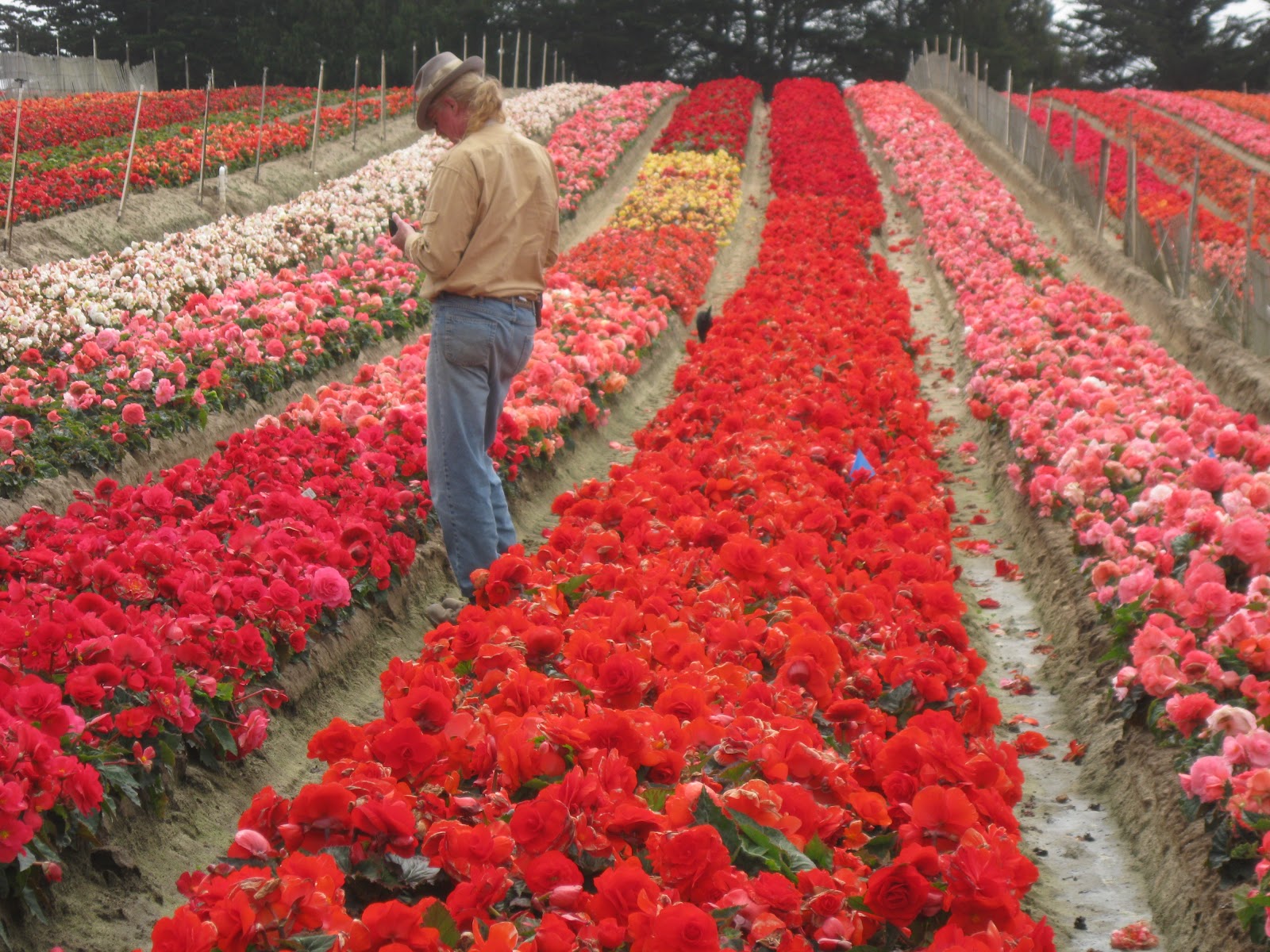
Below is a shot of cross #12012200. A pink roseform. Notice the high percent of fully double flowers and how they are presented on top of the plant.  This looks like it may be a good cross!


Using these techniques, Golden State Bulb Growers has been able to produce products unique on the world market.  Our lace begonia series, a reverse picotee, is not available from other begonia breeders.  As a result, we sell seed of this series to large begonia tuber producers in Europe.  In fact, European begonia producers produce more tubers of this series than we do here in the States, all from seed we sold to them.


Red  Lace on our porch

Appricot Lace, GSBG  Photo

Our Daffodil Begonia is an old type first noted as a mutant variety in 1896, we have kept this type in breeding and in production and have made improvements.  It is considered very rare.  J. Haegeman in his book Tuberous Begonias notes them as being variously named “B. Tubereauz a fleur de narcisse”, “Daffodil-flowered begonia”, “B. narcissiflora” and several other names.  He finishes the chapter on this begonia by writing “As this group is no longer found in commerce, any discussion of its name has only a theoretical value.”  Well, it is still in commerce and we are the only ones to have it.  It is, in my opinion, a product for a collector not for the person who likes an easy to grow large flowered begonia.


Salmon Daffodil GSBG Photo


Breeding programs are expensive and their pay back is very long.  Sales of the product have to support the program.  When sales are slow, the breeding is the first thing to be limited.

-Andy Snow

Wednesday, July 11, 2012

Back in the Day


I have a confession to make.  I didn’t start this job because I loved tuberous begonias.  I started this job because I needed the work.

I guess you could say the job started in Northern Australia.  Broke in Asia, I needed work then too, badly.

In order to get into Australia as a tourist, I needed a ticket out of the country.  I bought the cheapest ticket I could before I boarded the plane from Bali to Darwin.  The ticket was to Kupang, Timor.  It took almost all the money I had to buy the two tickets one to Darwin, one to Kupang.  I sat on the plane with less than $20 in my pocket, I was deadly afraid that the customs guys would take one look at my wallet, not let me out of the airport and send me off again, and I would end up broke in Timor (not a good prospect).  
I sat next to an Australian on his way home from a vacation in Bali and I talked to him about my dilemma.  He loaned me the $300 in his wallet.  Just put it in my wallet, walked through customs (they looked at my meager funds and found them adequate) and I gave it back to him on the sidewalk outside the airport, the air heavy in that tropical way.

Darwin had been struck by Cyclone Tracy about three months before and was actively trying to rebuild, I found work the next day.  Taking a job on a tourist visa and overstaying my allotted time, made me an illegal alien.   Australia had an amnesty offer  a year or so after I arrived and I got my visa straightened out.

Construction work was lucrative and easy to find but inherently unsatisfying.  Thinking about what I would like to do, I knew I wanted to be a gardener and grow plants.  By that time I had fallen in love with the tropics and it's flora. 

I got a job working for the Northern Territory Parks Department.  They assigned me to Government House.   It is the residence of the “Administrator”, what we (in the U.S.) would call the “Governor”. The residence was maintained by the Parks Department.  It was such a great job, a wonderful tropical garden overlooking the harbor, but not a public place.  The Administrator never came out of the air conditioning and we gardeners gardened for ourselves.

Below you see a photo of Government House.  I’ve been to the top of those palm trees many times.


Government House, North Australia


I started propagating plants in a unused portion of the garden, first for my use and then for the other parks and got a pretty good raise and a title of “Propagator”.  Oh, that was the life.   The stories I could tell, don’t get me started.

Soon though, I knew I had to come home again, I left by a  wooden sail boat. It took 2 years to get home. I also knew that I would settle in California, I mean… where else?

I didn’t want to grab just any job, I wanted back into horticulture.   One afternoon, I drove to the top of Hecker Pass and looked over the Pajaro Valley.  At that time the valley was full of greenhouses, you could count hundreds.  I thought to myself “I can find work here”.   I went from place to place with no luck, several people recommended I go to Half Moon Bay and get a job at one of the big wholesale places.  Most of those greenhouses I saw from Hecker pass are closed now.

At the time, I was staying in my van, parked in an old friends driveway in Capitola and for amusement (being broke) walked about in the evenings.  One evening I walked by a place called the “Brown Bulb Ranch” which I thought amusing.  I mean were the bulbs brown? Or what?  Just outside the fence was a little shack, covered with little pink roses, Paul’s Himalayan Musk I think.  I have always liked shacks and thought to myself, “ I could live in a place like that”

I applied for work at the “Brown Bulb Ranch” the next day.  It was just a couple days before begonia harvest of 1983 and the ad for help was going to appear in the next day’s paper.  They hired me, and my first job was unloading 100 pound sacks of tulips for minimum wage, $3.35 per hour.

They kept me that harvest season, they kept me though the propagating and planting season, they kept me though the summer.  The next year the old greenhouse manager retired and her right hand helper was not comfortable taking on the job.  They offered the job to me! 

I have to confess, I did not fall in love with tuberous begonias.  I fell in love with my job.  I liked the old greenhouses.  I liked the smell, the touch and look of those greenhouses (even though the doors were so low I had to duck to get in).  I liked watching the little plants grow from seed. Seeds small as dust.

Believe it or not, I did end up living in that shack just outside the fence.  And it was a real shack. Built around the 20’s for Filipino dairy workers, I couldn’t stand up in the kitchen or bedroom because the ceiling was too low.  The roses good.

As the “Greenhouse Manager”, I could not stray too far from the greenhouses.  The vents were not automatic and required the pull of a chain or rope to operate. I could go out on weekend mornings but when the fog cleared, I had to return promptly to open the vents before the houses got too hot.  Likewise, in the evening, I had to close them. If the fog blew in early, I had close them then.  Seven days a week.  For me, this was not a problem.  I didn’t have anywhere else I wanted to be.  I lived at that place and for that work.  I thought it was kind of like sailing a boat.  I read books.  I made a vegetable garden in the back yard.  I cleared a huge patch of blackberry vines and found a house under it.

Below is a picture of me outside my “office”.  We were doing some underground work across the road and I propped the camera on the rubble pile, set the timer, ran over and struck a casual pose.


Andy at the Brown Bulb Ranch


In the winter evenings, when the begonia seedlings were in the greenhouses, I would go around and light the heaters.  For the most part the heaters were a pipe with holes drilled along the top with a line of gas fed into one end with a valve on the inlet.  I would kick the valve open with one foot and toss a lighted match in the general direction of the pipe, and the flame would come on with a satisfying “whoomp” and dance about three feet high in the middle of the greenhouse floor.  Had to turn them off in the AM too.

The begonias were sown by hand in redwood flats.  Below you can see a picture of me sowing them.  Sometimes I would get behind and return after dinner to finish the sowing.  The propagation greenhouses were a balmy 78 degrees in middle of winter, they had heat that ran as hot water in pipes under the benches from an antique boiler. I put classical music (KBAQ when they were still classical) on a little radio at one end of the house and would finish my work, sometimes not until 10:00 at night.

Sowing open flats of begonias at the Brown Bulb Ranch


Although the greenhouses were old, they were scrupulously clean.  The redwood benches in the propagation houses were painted every year, before sowing, with a 50–50 mix of diesel and formaldehyde.  They had a kind of oily green color from so many years of this treatment they looked like particularly ugly ebony.  The flats were steamed in a big old pressure cooker that was bought when the canneries from Cannery Row closed in Monterey.

There were many little out of the way corners in the Old Ranch.  There was a small greenhouse off the propagation houses, maybe 20 x 30, glass roofs like most were, old Lord and Burnham chain pull vent openers. The house hadn’t been used in years and was full of whatever wanted to grow there.  There were lots of tomatillos gone wild that filled one side to the gutters.  The tomatillo fruits would dry in their papery skins until they were like big fat blond raisins.  I would go in a pick a few once in a while during work.  

One day, I don’t remember why, I was instructed to get this greenhouse back into operation.  That meant fixing whatever was broken and taking the floor back to clean dirt.  Before I started on the floor, I was struck by how beautiful it all was.  I ran home (I was living in that shack by then) and got my camera.  Below you see a picture of a little weed arrangement on the floor. Some sort of begonia-gone-native in the middle. By the afternoon this photo was taken it was all dirt again.

I became interested in how greenhouses worked (and in how to automate them; selfishly) and in how to improve the crop that became my charge.  I was going to the local community college at night and taking all the hort classes I could.

We left the Old Ranch in 1989, the year of the Earthquake, and built a new facility in Moss Landing.  The greenhouse are all controlled by an environmental computer now. One that has been upgraded through the years. 

I now sit at home, fifteen miles away, and look at the condition of the greenhouse on my computer, cup of coffee in hand, and change the set points, open a vent, turn on a heater, or whatever, with the touch of a key. I’m removed.  I’m here, they are way over there.

Looking back, it seems wonderful.  Begonias gave me a life. Who knows what I really thought then, time has turned it all to myth in my mind.