Friday, August 2, 2013

The Next New Thing and this years Pack Trials


Golden State Bulb Growers’ participation in the California Pack Trials is long past.   All the begonias for next season's harvest are already planted.   I had hoped to write, in a timely manner, on all these activities, but it’s amazing how the days go when the pace picks up. 

The pack trials were very well attended this year.  Why?  The improving economy? An upswing in our industry?  New exciting products?  Really it was probably just the lousy long winter most of the country had while we had an early and glorious spring.  Who wouldn’t want to leave gray Indiana for a nice week-long, expense paid, jaunt in sunny California?  Rent the convertible Mustang; hey it isn’t that much more than the base model.

California Pack trials are all about what’s new.  The Trade Journal writers show up, ask; “What’s new?”  take photos of the latest new thing, get back in the rental car and on to the next place (get the Mustang next time). 

We made a bench of just our new stuff so they didn’t have to waste their time looking at all the old stuff.

What’s new is not necessarily what’s better.

Someone asked me, while we were standing in the begonia house “So, these are all your creations then?”

“Umm, no.” 

“I inherited the program from the previous breeder and I will pass it on to the next” 

 We make incremental changes and variations on a theme, does that count as new?  On Tops®, are they new?  I made those first crosses 20 years ago.

Tuberous begonias are good, we’re working on them, they’re not new, they’re better.

Let’s look at a few photos from the pack trials.


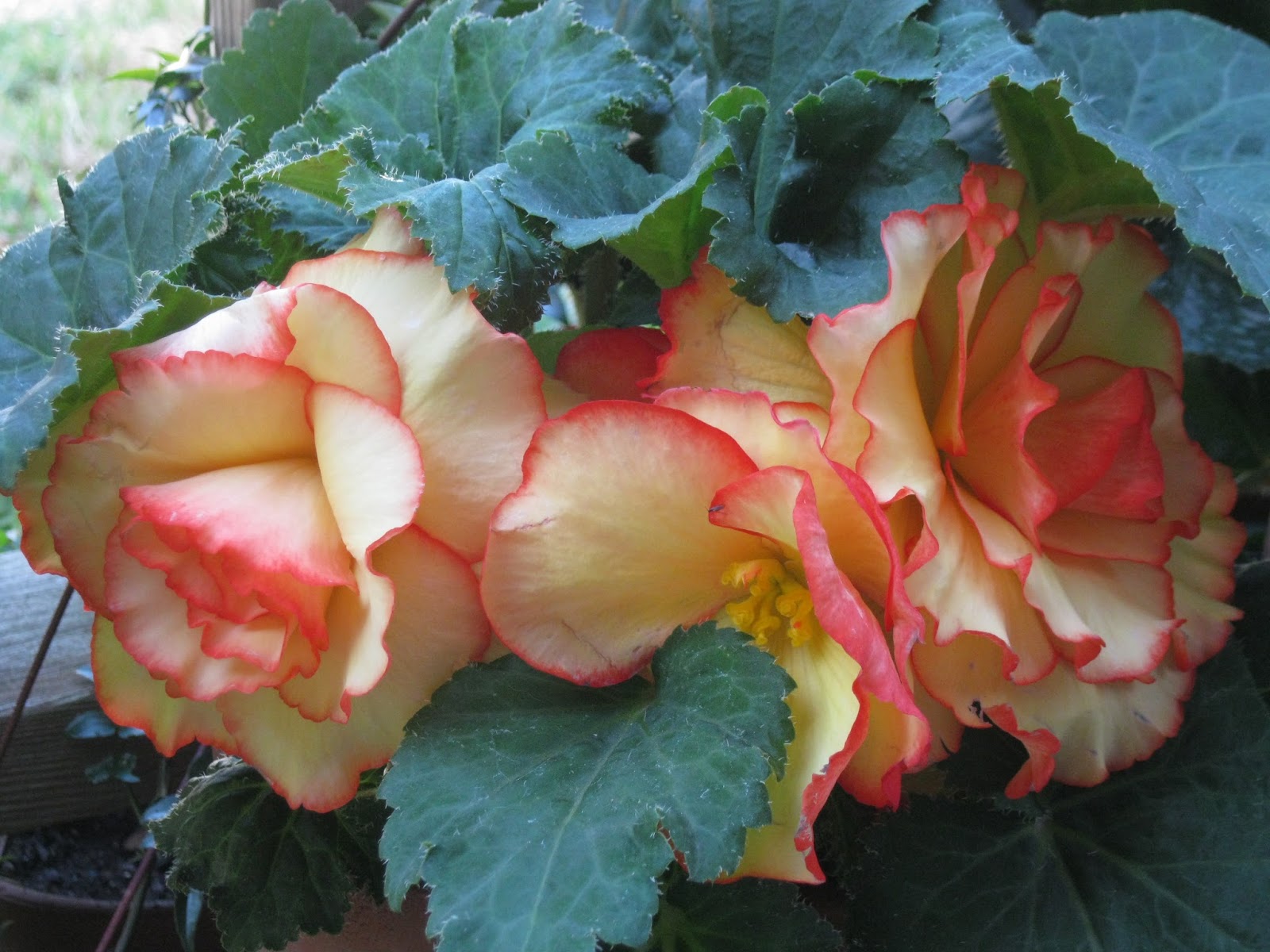
My wife says this looks Photo-Shopped.  It's not.  Our #11 Ruffled Orange.


Trial Bench, 6 inch pots on the left and 8 inch pots on the right.  They like the room in the 8 better, the bigger the pot the better.


Begonia House 2013 Demos.


For Golden State Bulb Growers, the Demos are mostly about Callas.  Here is the center piece of the calla house.


AmeriHybrid and Antonelli cross gone, frankly, a bit over the top.
 So, our begonias are not the Latest New Thing.  I don’t want to brag too much, but I think if you compare the begonias we are growing now with the begonias that were photographed by Ansell Adams, you can see that we have improved in a mere (!) 63 years since those photos were taken (only 30 of those years have I had any hand in this).

Thanks and good luck in the future.  -Andy

.

Thursday, June 13, 2013

Begonias in Our Garden


                                                By Laura Crum


            Since Andy has been too busy to post here, I thought I’d give you a brief guest post (I’m his wife). I am not a great gardener by any means, and no expert on begonias. But I do have some very pretty tuberous begonia plants in my garden, which were raised by Andy from crosses he made for Golden State Bulb Growers. I thought you might enjoy seeing them.
            Here is the hanging basket begonia Andy gave me for Mother’s Day (salmon hanging basket begonia if you want to acquire it).


            Here is the plant he gave me for my birthday. A picotee upright—a new cross between the Amerihybrid begonias and the Antonelli lines. This one isn’t available for sale yet, but may be soon. In case you missed it, Golden State Bulb Growers bought Antonelli when that company went bankrupt, and is doing the best they can to keep the Antonelli lines in commerce.


           Red lace begonia on our front porch.


            And another picotee with some Antonelli blood on our back porch.


            An apricot hanging basket begonia grown rambling between other plants.


            Sunburst picotee begonia.


            So, not much of a post, but thought you might enjoy seeing some of the begonias Andy and I actually have in our own garden. Andy promises a better post soon. Cheers--Laura


Tuesday, February 12, 2013

Seeds

Seed Season,

“Don't judge each day by the harvest you reap but by the seeds that you plant.”

We’re planting begonia seeds again.   We’ll drop over 2 million little begonia seeds and hope for the best. 


Wee begonia seeds


Have you ever thought about seeds?  Seeds are amazing.  Seeds are like little time capsules, little messengers of hope for the future. Planting seeds is to throw your lot in with the future. 

Little packets of information.   The tree (or begonia) is not contained in the seed only the code that will unravel, through a complex Boolean network, into it’s own unique natural shape.


15,000 begoina seed. In this case, Hanging Basket White


“It always amazes me to look at the little, wrinkled brown seeds and think of the rainbows in 'em," said Captain Jim. "When I ponder on them seeds I don't find it nowise hard to believe that we've got souls that'll live in other worlds. You couldn't hardly believe there was life in them tiny things, some no bigger than grains of dust, let alone color and scent, if you hadn't seen the miracle, could you?”
― L.M. Montgomery, Anne's House of Dreams

“Seeds have the power to preserve species, to enhance cultural as well as genetic diversity, to counter economic monopoly and to check the advance of conformity on all its many fronts.”

We have all come from seeds you and I.  Little seeds that were planted on fertile ground.

two million seedlings at about eight months, one sprout at 6 years.

It now seems likely that all life on this planet came from a seed.

You see, back in the long-ago the world was a tumult.  There were complex chemicals as a result of volcanic and other turmoil but no organization.  The planet was bombarded by meteors and comets.   Into this torment came a seed.  From space.  A template. The template organized the complex molecules so that they could replicate themselves.  I’m not making this stuff up. Several people have written about it.  Read one article here.  The pattern arrived and the complex molecules arranged themselves in the pattern, modified themselves and (using the pattern as a means) passed on their modifications to their off-spring.

All life is pattern.  You and I do not have any part of us that was with us only a few years ago, the only consistency is the pattern.  Your pattern, my pattern. 

Life grew from seed, it made multitple models and the patterns grew ever more complex.

So if all life came from a seed, and the seed came from outside, and it found a fertile, warm space to land and to grow, can we literally think this planet is our mother?   Are we unborn in our mothers womb?  The sky is our father, the earth is our mother (sound familiar?).  We can no more imagine what we carbon creatures are to become than an unborn child can imagine breathing air and running in the sun.


Maybe it’s not reasonable to believe in a star-seed.  But we humans abound with unreasonable beliefs.  Old legends or old documents translated many times by people, each with their own agendas, you know what I mean. 

I remember hearing about an anthropologist who visited an island in Indonesia where their cosmology said the universe rested on the back of a turtle (a belief held, by the way by several cultures including some native Americans, Chinese and Hindus).  When interviewing old people living a traditional life style, the anthropologist asked an old lady.
“What does that turtle rest on?” 
The old woman answered “Another turtle” 
“And what does that turtle rest on?” asked the researcher. 
“Don’t start with me, young man” she said wagging her finger at him “It’s turtles, turtles, turtles all the way down”

Yea, I know, funny story.  Are our beliefs any better?

Unquestioned faith doesn’t really make us fully human, does it?  Unquestioned faith is what makes a young man, with his whole life in front of him, blow himself up on a bus crowded with strangers or kill hundreds of people with an airplane, people who have never done him any harm.  Programmed.

Let’s agree not to live by faith, but to live through knowledge.  Don’t let’s mistake what we know for what we believe. 

Life is a big unknowing.  There are some things we can never know.  And let me tell you one thing for sure: people who say they know; they don’t know any better than you and I.  People who say they know are telling you what they believe and they are confusing what they know with what they have chosen to believe.  Consciously or unconsciously we all choose what to believe.

Let’s walk out into the stream of unknowing, you and I.  Let’s move from one rock of what-we-know to another rock of what-we-know ‘till we are standing on solid ground in the middle of the mystery stream and can go no further. 

Because of our limits, we can’t see the other side nor move forward with certainty.  We may have an idea about what’s on the other shore and the path to get there, we can have a belief about where we’re going.   We can decide we really believe in our conclusion and have faith we are right.  Let me know what you believe.

I believe in seeds.

To see things in the seed, that is genius.


Saturday, January 26, 2013

Tuberous Begonias, Color Photos by Ansel Adams


“The Mockingbird Flower”


September 19, 1950 Life Magazine.


The text reads: U.S BREEDERS GLAMORIZE ONCE HOMELY BEGONIA When Charles Plumier, the French botanist, came upon a strange new flower in the West Indies about 1690, he named it for Santo Domingo’s Governor Michel Begon and took home a specimen.  The begonia was interesting botanically, but it was not very striking: its blooms were small, nondescript and dwarfed by the plant’s jagged leaves.  European horticulturists improved on the tuberous begonia’s looks, but after 200 years it was still a rather plain-looking flower.  About 1920, however, U.S. flower growers became interested in Plumier’s plant and began crossbreeding on a big scale. In 30 years they have transformed the begonia as no other flower has ever been changed so short a time.  The little wildflower has been turned into one of the most spectacular.  Hundreds of new varieties have been created, some bright solid colors, some specked, dome with frills and beards.  Their lush blossoms are often a foot in diameter.  All the begonias on these pages (except the one at the right) are new American types, developed principally in California at the Brown Bulb Ranch and Vetterle and Reinelt farm, which together produce more that 90% of U.S. begonias.  These firms have developed so many new strains, some resembling such well-known flowers as the camellia, rose and carnation the begonia is now referred to as the “mockingbird flower.”


Here in the West we value Ansel Adams, and his photos, very highly.  His black and white photos of our mountains and wild places had a huge influence on our view of wild places and the development of park systems to (ideally) protect them.

The fact is that Ansel Adams took in a lot of “commercial” work to pay the bills.  He was highly regarded as a commercial photographer and the glorious art prints we have come to associate with him did not pay the bills until later in his life.

He wrote to his friend David McAlpin as early as 1938, “I have to do something in the relatively near future to regain the right track in photography. I am literally swamped with “commercial” work — necessary for practical reasons, but very restraining to my creative work.”

As some of you know by now, I work as the begonia breeder for Golden State Bulb Growers, a company that used to be known as the Brown Bulb Ranch.  The Brown Bulb Ranch was located in Capitolia, California, and in 1950 was being run by Worth Brown, son of founder, James Brown.  When Life magazine commissioned this article on begonias, they hired Ansel Adams to do the photography.

During this photo shoot of the Capitola begonias for Life Magazine, Mr. Adams stayed in the adobe house of Worth and Jane Brown at the Brown Bulb Ranch.   Barclay Brown, son of Worth and Jane,(and my father-in-law) remembers Ansel Adam's visit clearly, Barclay talked to my wife and me about it at dinner the other day.  Barclay would have been around 18 at the time.  Worth and Jane reminisced, when they were alive, about the visit of Mr. Adams.  By the time of his visit, he was well known and Worth and Jane were active in society and interested in art and, I imagine, pleased to be hosting so eminent an artist.. Barclay told us Mr. Adams played the piano after dinner.  Mr. Adams taught himself to play the piano at the age of twelve. He was an accomplished pianio player and music was, at first, his intended occupation.


 I was surprised when I first saw these photos many years ago at the Brown Bulb Ranch because I did not realize that Ansel Adams had any color photos in circulation.

I hope you enjoy these photos as much as I do. 


The text reads: “A Flood of Flowers fills the greenhouse at the farm of Vetterle and Reinelt at Capitola, Calif.  Most of them are standard tuberous begonias, of all shades and colors, but at the top of greenhouse are hanging basket begonias, which are just coming into popularity.  Begonias can be grown either from seed or from tubers. To get them to produce seed they must be hand-pollinated.  Bees and insects do not do a very dependable job of fertilization, possibly because the begonias have little or no fragrance.  Their season, which began in May, will last another few weeks.  One big asset of begonias is that they are comparatively free from plant diseases."


The Text Reads: "A Fiery Guard over a field of begonias is this oil heater on stilts, which sends out infrared radiation to protect an acre of flowers or vegetables against frost.  Begonias generally fare best in moderate climate like that of California, but hardier species are being developed to withstand a wider temperature range."


  Ansel Adams even took some photos of Worth and Jane and their sons Barclay and Todd during his visit.  We found the photos in an old album that belonged to Worth and Jane.


Notation says "1949 taken by Ansel Adams" Worth Brown on the left and family portrait on the right.

 I want to leave you with my favorite Ansel Adams photo.  Moonrise, Hernandez New Mexico.   Although I like the photos he took of  wild places, I really like this one because it's both wild, lonely and inhabitable.


Best Regards -Andy

Saturday, January 19, 2013

Degrees of Good

Or: Up from industry.. to what?

“The best is the enemy of the good.” Voltaire

What Voltaire meant by this famous quote is that we often sacrifice what’s right, fine and, good to try for something that’s maybe just a little better. 

I know several people that are excellent in their chosen field.  Excellent martial artist, excellent musician.  The thing is, their lives are all screwed up.  Because life is about balance, not extremes. Excellent is extreme.

I am a believer in moderation in all things. Of course you have to include moderation in that equation too.  I mean come on, don’t take your moderation to an extreme. Get excited about something.  Play music ‘till late at night once in a while. Prune your front hedge to look like circus animals and dinosaurs. Or whatever.

What does this have to do with begonias?  Why does it always have to be about begonias?

I’ll tell you.

Judith Taylor in her article, The Begonia in California wrote “The Brown Bulb Ranch grew tuberous begonias on an industrial scale in Capitola for many years. The firm saw the possibilities in the mass market and grew millions of plants each year”

I don’t know about you, but it kind of makes me feel like we’re Folgers coffee or Budweiser Beer. 

 We’re better than that, maybe not excellent, but good, we were back then and we are more so now.

It is a fact that we have based our business, whether begonia or calla, on seed.  Our company was very involved in developing true seed strains of tuberous begonias (our company history says we ARE the developers of lines that are true for color)  Previous to true lines, all tuberous begonia hybrids were vegetatively propagated and very expensive.  Seed lines enabled us to bring the price of tuberous begonias down and produce millions for the market place.  That’s good, maybe it’s not excellent, but is it industrial?

 My job is to breed seed lines that are as good as I can make them.  But the fact is that all seed lines are kind of a crap shoot (except true F1s).  The genes recombine and the dice roll.  I have some lines in which every male bloom is a solid multi-petaled double.  Others, well, not so much.  I look at all our 54 varieties and decide which are the weakest. Then for a few years, we work on those and improve them.

The only other successful seed grown begonia is the Non-Stop.  A popular begonia with smaller flowers suited to garden beds and, so I am told, very popular as cemetery plantings in Europe.  In parts of Canada, Non-Stop is synonymous with tuberous begonia; like Kleenex is synonymous with face tissue, (again something I’ve been told).

Our equivalent to the Non-Stop is the On-Top. Get it? Non-Stop, On-Top.  The difference is ours are all bi-color or picotee because, at the time, we didn’t want to go head-to-head with Non Stops in the market place (they were too cheap).  Now they have picotees too, so it goes.

But our “standard” begonia is the large flowering “exhibition” type begonias (and hanging baskets).  You know, the spectacular ones.

Among the large flowered begonias there are degrees of good.  (And that’s only if we all agree on what’s desired in the realm of floral beauty, other opinions are welcome.)

Our seed lines knocked the socks off of Antonelli's seed lines.  I know, I grew Antonelli's begonias.  They brought me their seed and I returned to them tubers.  They had their own mother stock and genetics.  From their mother stock they took cuttings.   They called them Antonelli’s Champions.  They were all identical.  The best they had (we have those plants now).

Antonelli's Champions.  Notice my highlighter over the size. "1 inch (sometimes smaller)"! Holly smokes!


Blackmore and Langdon.  Great begonias. There's a mark for us to shoot at.  We could pick on them for this or that, I don’t like the fact that some have weak stems and don’t hold up the flowers very well.  But then again, the flowers are often huge.  Vegetatively propagated.  Expensive.

In some ways, cloning begonias is easier, you only have to find one good one.

The breeding may be easier but the production is harder and therefore, more expensive.

We vegetatively propagate only our Scented Begonias.

We used to have a program of named varieties that we (inside the company) called “Stake Stock” that were selected (staked) while the plants were in bloom and then hand dug before the Green Monster went through the field.  I’ve tried to reinstitute that program a couple time, with no success.  The sales department didn’t sell them, the warehouse crew threw them out and when  I sent a couple of the tubers to Paul Carlisle and I saw them in his greenhouse, I was not impressed with the results.  We will have to improve our performance if we want reinvigorate that program.  Next year, I will make the selections myself.

"Stake Stock" in our 1978 Catalog

Cover from the catalog above


But, let’s run the numbers.  Let’s say 5% are junk, 90% are good and 5% are excellent (or maybe it’s 10%-80%-10% or  20%-60%-20% whatever).  Do you want to pay me to find the 5% for you and charge you for that, or do you just want to buy a few tubers for the same price as the one I selected and take your chances?  You might get the junk, you’ll likely get the good and you might get the great.  The collection of begonias that you decide to keep will reflect your taste, not mine.

So, the question is, and why I started writing all this about three pages ago is this; I am wondering if we should start a vegetatively propagated begonia program for more than just Scented Begonias?  It’ll be two years before the first ones could come along.

Should we have three degrees of good;  the Clones, the Stake Stock and the Seed Lines?

Could we become less “Industrial” would we become “boutique”?  Or is that just one more way to lose money?

Other news and note in our tuberous begonia world.  Paul Carlisle and his lovely wife Laurel had a great article in the “Begonian”, which is the magazine of the American Begonia Society.  Great article, great photos and a wonderful cover shot by Gary Hunt.


For more of photos of Paul’s begonias by Gary Hunt clink here.

For an article I wrote about Paul click here.


-Andy

Monday, December 24, 2012

The Green Monster and a 5 foot Horizontal Blue Flame


Or Here We Go Again!

It’s tough this time of year. I never liked winter, that’s why I moved to California forty years ago, but there’s always winter, isn’t there? 

The days short, I go to work in the dark and return home in the dark, morning and evening chores are done in the dark.  Moods are dark, the weather dismal.

I was so happy last Friday when at 3:12 am we finally turned the corner and our half of the planet started to turn toward the sun instead of away from it.   Better days are ahead.

It is at this time of no-flowers-anywhere that we dig our begonia crop.  It’s the busy season, the soil and sky dark, wet, and heavy.  Dark, wet and busy, the joy of this season evades me. 

As I write this piece, two days before Christmas, the rain is bucketing down and has been for days. 

The begonias were happily going to sleep in their wet soil, maybe they would have died there, maybe they would have risen next summer and been a glory again, but they are saved from whatever their fate might have been now that they are meeting the Green Monster. When its time has come, The Green Monster is called out. The Green Monster stops only for dark- not rain, not mud. 


The Green Monster
The Green Monster, surrounded by his attendants, moves through the begonia fields


An old piece of agricultural equipment, the Green Monster is not used for any other purpose than to unearth begonia tubers.  The Green Monster is a modified potato digger; the blade passes under the tubers and they are lifted onto a broad chain that jumps a little on a small cam to shake some of the sand off. Then the lumps of soil are unceremoniously dumped into a bin, each with it’s tuber inside, and transported to Moss Landing, where most of the remaining soil is washed off and the begonias are dried, sorted and sold.

The washer dumps lots of recirculated water on the tubers, two settling ponds collect the Marina sand that gets hauled away in summer. And there’s the dryer.  Oh, the dryer.  The dryer is 3 standard shipping containers placed side by side and cut so that a hot wind driven down the center container is divided and driven back up the outer two.  The begonias, wet after being washed, are stacked on pallets and are subjected to this hot wind.

Many years ago the Brown Bulb Ranch dried apple pulp.  There were several companies around here that pressed apple cider and the pulp was recycled, after drying, to various uses.

One of the many burners that dried apple pulp now dries our begonias, supported by a big fan.  It’s magnificent in it is extravagant consumption of natural gas!  See below the video I took today of the begonia dryer.


This will be the thirtieth begonia crop that I have seen harvested, washed, dried, graded, counted, and shipped.

They hired me for just this work.  Thirty years ago I was big, young and strong (now I’m just big).  We used no equipment to unload the begonia boxes that arrived at the Brown Bulb Ranch from the fields; they arrived in wooden boxes on a flat bed truck. We unloaded them and dumped them, one by one, on the washer chain. Keeping track of the varieties by their numbers. We listened to football games on a little black radio that we kept dry.  It rained.

One more time, here we go again.  I wonder if I prayed to one of the ancient gods of agriculture, if they could lift the weight off me during this season and I too could rejoice in colored lights and wrapped packages. 


Turn towards the sun, little blue marble, the light is coming back, we are going to be born again, I am almost sure of it. 


Andy 

Wednesday, November 28, 2012

That’s not what I want to talk about.

Excuses, excuses, excuses

Well so much for my goal of getting out a couple blogs each month. 

I guess everyone has excuses, me too. 

We started calla harvest the middle of September and there are calla bulbs (or corms or tubers, whatever those confounded things are) everywhere. The warehouse is overflowing and they are stuffed into greenhouses and the old derelict mushroom plant down the road. 

But that’s not what I want to talk about.

I also went off in the middle of this busy time to study music with Fred Morrison for 4 days at Lake Tahoe. It was great fun and the weather and venue very pleasant.  The days challenging and the music after dinner delightful. The music just flows though Fred Morrison, like he’s some kind of conduit, and he gets such a kick out of it that he grins and laughs while he plays, like it tickles. This link shows Fred playing the Low D Whistle with his pipes on his lap.

Fred Morrison playing bellows blown Smallpipes

 But that’s not what I want to talk about.

We had a visit from Matthiuas Rohde of Rieger Begonias.  Rieger is in the business of producing begonias from cuttings.  They produce a begonia that is a cross between species of which one species is a tuberous begonia.  These crosses are also sometimes called hiemalis begonias.  But in our industry, Rieger’s begonias are so ubiquitous that their family name has come to mean a whole class of begonias. Mr. Rohde is the head of the family business now and a direct descendent of great grandpa Rieger.  Grandpa Rieger had only daughters and so none of the progeny carry his name.  Pity, I could have had my picture taken with a Mr. Rieger standing in our begonia fields.

We have a deal with Riegers where they will try and propagate our Scented Begonias from cuttings.   Since cutting begonias is their business (Riegers do not come true from seed), it stands a chance of being a way to get our Scented begonias to market.

But that’s not what I want to talk about.

I also had the wind taken out of my sails the other day. 

See, I was checking the links on this blog, the ones you see on the right, just to make sure they were all good.  ABS; check. Capitola Begonia Festival.  Check.  University of Minnesota:  Check. Our web site “Your Source for AmeriHybrid® Begonias”…our begonias…I got the message you see below.


What! No begonias?


I wrote, in a earlier blog, about our company culture being basically anti-retail but we aren’t even selling our own begonias! 

I, of course, went to talk to the sales guys and they gave me lots of disclaimers, reasons and qualifiers but said basically “we can’t have begonias on our web site or someone might buy them.”   I let that sink in a minute.

I went to our new CEO (me, rather disgruntled) CEO says he’s totally behind getting the begonias back to profitability through increasing sales.  Good for him.   He says there’s a new web site in the works. Good for him.  Going to be called CAbegonias.com.  “Good for you” says I, “when will it be up?” “End of January” says he.  Sooner, we all hope.

There’s some sort of ego thing going on here I know there is.  And I know, it’s my problem.  For 29 years I have bred tuberous begonias and I want to see them out in the public.  I like it when people are complimentary about the plants.  I even get some weird kind of second hand satisfaction when people grow our competitors tuberous begonias and like them.  And of course, now I’m blogging; another sign of an obviously out of control ego.

My wife says I need to detach.  I can, I suppose, continue to breed begonias for my own pleasure until our company declines to grow them any more.  Why would we stop growing them?  Well, because we don’t sell them!

Note:  Our begonias are available. Do a search for AmeriHybrid Begonias.  There are some nice web sites out there with our material that you can actually purchase.  I have updated the sidebar with some suppliers.

But that’s not what I want to talk about.  Not at all.